

June 01, 2026
article by the prompt team

Most business owners spend the majority of their energy chasing growth. More sales. More clients. More revenue. And while that ambition is entirely right, there is a quieter, less glamorous side of running a business that determines whether all that growth actually translates into lasting success — or quietly leaks away.
That side is financial controls.
You can be generating strong revenue and still find yourself in serious trouble if the systems managing how money moves through your business are weak. Fraud happens. Cash disappears in ways nobody can fully explain. Errors go undetected for months. Reports that are meant to guide decisions turn out to be inaccurate. And by the time the problem becomes visible, the damage is already done.
This is not a challenge exclusive to large corporations. Across Ghana, businesses of every size — from sole proprietorships in Kumasi to growing SMEs in Accra — are learning, sometimes the hard way, that financial controls are not optional extras for businesses that have “made it.” They are the foundation that makes sustainable growth possible in the first place.
This guide breaks down the essential financial controls every Ghanaian business should have in place, why they matter, and how to start building them.
Here’s what we’ll cover:
- What financial controls actually are
- Segregation of duties
- Bank reconciliations
- Approval and authorisation controls
- Proper record keeping
- Budgeting and financial monitoring
- Access controls and financial security
- Why financial controls build trust
- Financial controls are an investment, not a cost
- Final thoughts
What financial controls actually are
Financial controls are the policies, procedures, and systems that govern how money flows through your business. They are the guardrails that keep your finances organised, transparent, and protected.
At their core, good financial controls help a business do six things: protect its assets, ensure accurate financial reporting, prevent fraud, improve accountability, stay compliant with legal and regulatory requirements, and build the kind of operational discipline that makes scaling possible.
The Institute of Chartered Accountants Ghana — the professional body that sets accounting and financial management standards in Ghana — defines financial controls as a fundamental component of good corporate governance for businesses of all sizes. Their guidance consistently emphasises that weak financial controls are among the most common causes of SME failure in Ghana, not just in large corporate environments.
In plain terms: financial controls help you know where your money is, where it is going, and whether the people handling it are doing so honestly and accurately. Without them, running a growing business becomes increasingly difficult — and increasingly risky.
1. Segregation of duties
This is one of the most important and most frequently overlooked financial controls in small and growing businesses, and it is worth understanding clearly.
Segregation of duties simply means that no single person should have complete control over a critical financial process from start to finish. When one person handles every step of a transaction — initiating it, approving it, processing it, and recording it — the opportunity for both fraud and undetected error increases dramatically.
In practice, this looks like: the person who approves payments should not be the same person who processes them. The person handling cash should not be the person reconciling the bank account. The person who creates new vendors in your system should not be the person who approves payments to those vendors.
These separations are not a sign of distrust toward your team. They are a structural protection for your business — and for the honest members of your team who should never be placed in a position where temptation or error goes unchecked.
The Ghana Audit Service has repeatedly highlighted poor segregation of duties as a leading contributing factor in financial irregularities identified during audits of both public institutions and private sector organisations in Ghana. The lesson applies equally to businesses of all sizes.
2. Bank reconciliations
A bank reconciliation is the process of comparing your internal financial records against your actual bank statement to confirm they match. It sounds straightforward. In practice, many businesses either do it infrequently or not at all — and that gap is where problems hide.
Missing transactions, duplicate payments, unexplained discrepancies, and unauthorised withdrawals can all sit undetected for months when bank reconciliations are not performed regularly. By the time the problem surfaces, tracing it back to its source and recovering the funds — if recovery is even possible — becomes enormously difficult.
Regular reconciliations should be a non-negotiable discipline in your business. For most SMEs, monthly is the minimum. For businesses with high transaction volumes, weekly or even daily reconciliations are worth the time they require.
The Bank of Ghana’s SME banking guidelines emphasise accurate financial record-keeping and regular account reconciliation as essential practices for businesses seeking financing, managing relationships with banks, and maintaining financial credibility with regulators and investors.
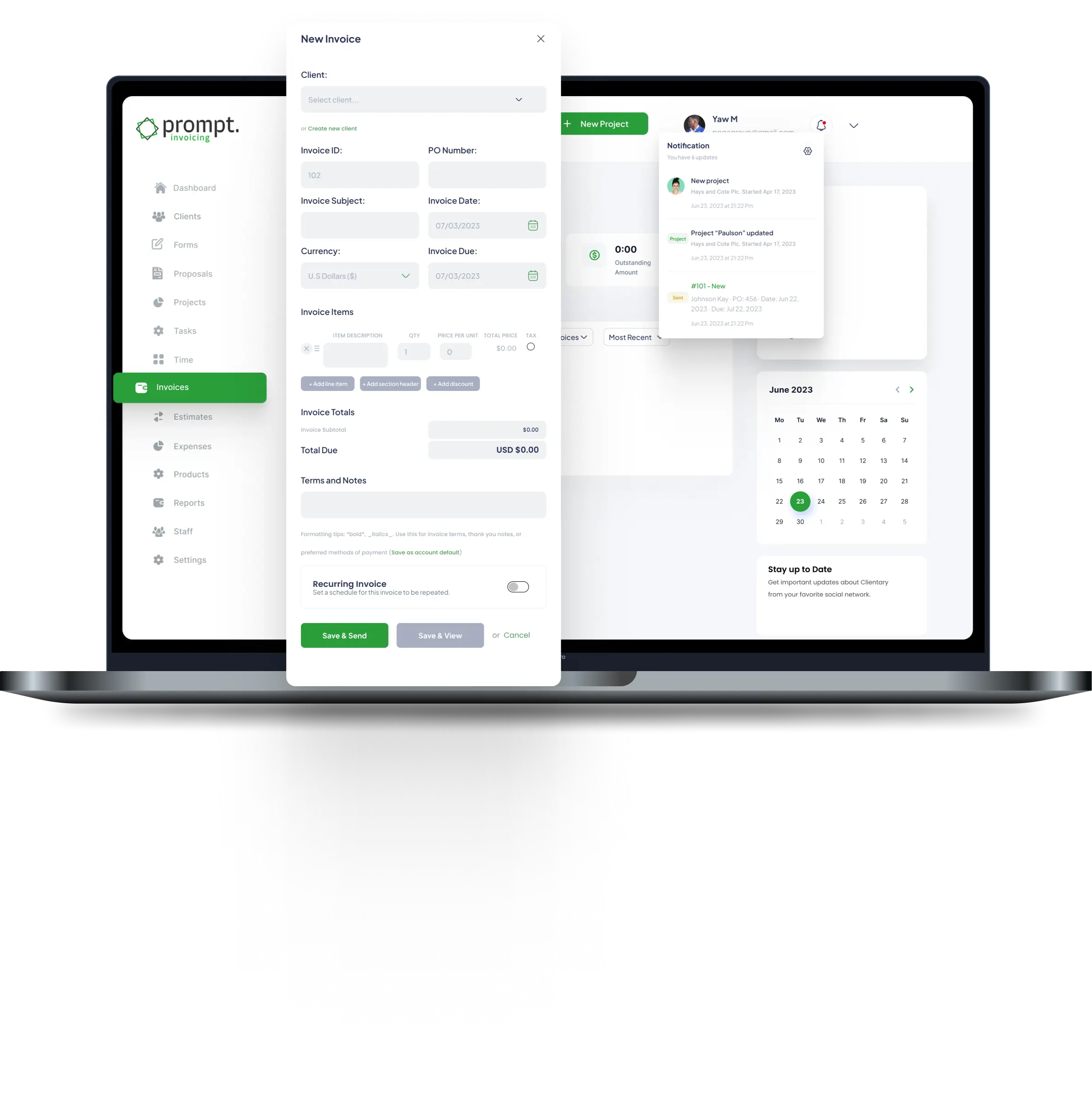
Prompt Integrated’s invoicing feature helps you maintain accurate, up-to-date records of every transaction — making the reconciliation process significantly faster and more reliable than manual, paper-based alternatives.
3. Approval and authorisation controls
Every significant financial transaction in your business — payments, purchases, expense claims, contracts, payroll changes — should go through a clear approval process before money changes hands.
Without this structure, businesses are vulnerable to overspending, duplicate payments, unauthorised purchases, and a general erosion of financial discipline that tends to worsen over time. When people know that expenditure will be reviewed before it is approved, spending habits change. When they know that nobody is checking, habits change in the other direction.
Authorisation controls do not need to be bureaucratic or slow. They simply need to be consistent. Define who has the authority to approve different categories of expenditure. Set spending thresholds above which a second approval is required. Make the process clear to everyone in the organisation so that it becomes a routine part of how business is done rather than an occasional obstacle.
The Ghana Revenue Authority requires businesses to maintain accurate records of financial transactions for tax compliance purposes. A well-structured authorisation process creates exactly the kind of documentation trail that makes tax reporting straightforward and audit-ready.
4. Proper record keeping
If you cannot produce documentation to support a financial transaction, it effectively did not happen — at least not in any way that can be verified, reported on, or defended.
Good record keeping means maintaining organised, accessible documentation for every significant financial event in your business: invoices issued and received, receipts for expenses, contracts with suppliers and clients, payroll records, bank statements, and tax filings. This documentation is the raw material for accurate financial reporting, and accurate financial reporting is the foundation of every other good financial decision you will make.
Poor record keeping creates problems in multiple directions simultaneously. It makes tax compliance difficult and audit exposure higher. It reduces the quality of the financial information available for decision-making. It makes it harder to identify errors or irregularities. And it significantly reduces your credibility in the eyes of banks, investors, and business partners who need to trust your numbers before they can trust your business.
The Ghana Revenue Authority mandates that businesses maintain financial records for a minimum of six years for tax compliance purposes. This is not just a regulatory requirement — it is a practical safeguard for your own business interests.
Prompt Integrated is designed to make record keeping genuinely easy for Ghanaian SMEs. From invoicing and expense tracking to payroll records, everything is stored in one organised, cloud-based platform — so your financial documentation is always accurate, accessible, and audit-ready.
5. Budgeting and financial monitoring
A budget is more than a planning tool. It is a control mechanism — a baseline against which you can measure what is actually happening in your business and identify problems before they become crises.
Businesses that operate without a budget are essentially flying without instruments. They may be generating revenue and covering costs on a month-to-month basis, but they have no reliable way of knowing whether their performance is tracking toward their goals, whether costs are creeping beyond sustainable levels, or whether a cash flow shortfall is approaching until it is already upon them.
The discipline is straightforward: build a realistic budget at the start of each financial period, and then compare your actual performance against it regularly — at minimum monthly, ideally more frequently for key metrics like cash flow and expenses. When you spot a variance, investigate it. An unexpected cost increase or revenue shortfall that is identified early can almost always be addressed. The same problem identified three months later is often significantly more damaging.
PwC Ghana — one of the leading professional services firms operating in Ghana — consistently advises Ghanaian SMEs that regular financial monitoring and budget variance analysis are among the most effective tools available for maintaining business stability during periods of economic uncertainty.
6. Access controls and financial security
As more Ghanaian businesses shift their financial operations to digital platforms — accounting software, mobile banking, cloud-based invoicing tools — the importance of digital financial security has grown in parallel.
Every system that holds financial information or enables financial transactions is a potential vulnerability if access is not properly controlled. Shared passwords, unlimited user access, and the absence of multi-factor authentication are all common weaknesses that expose businesses to fraud, unauthorised transactions, and data loss.
Strong access controls are not technically complex to implement. Use strong, unique passwords for financial systems and change them regularly. Restrict user access so that each team member can only see and do what their role requires. Enable multi-factor authentication wherever it is available. Maintain backup systems so that financial data is never at risk of being lost permanently.
The Cyber Security Authority of Ghana — the government body responsible for cybersecurity regulation and guidance in Ghana — provides accessible resources for small businesses on protecting digital financial systems. As Ghana’s digital economy continues to grow, the threat landscape evolves alongside it, and staying informed is a practical part of running a financially secure business.
Why financial controls build trust — not just security
Here is something that is not talked about enough in the conversation around financial controls: they do not just protect your business internally. They change how the outside world sees you.
Banks evaluating a loan application look at the quality of your financial systems. Investors conducting due diligence look for evidence of financial discipline before committing capital. Large corporate clients and government procurement processes increasingly require demonstrated financial governance as a condition of doing business.
Businesses in Ghana that have invested in strong financial controls consistently find that it opens doors. Stanbic Bank Ghana and Absa Bank Ghana both offer preferential financing terms to SMEs that can demonstrate organised, accurate financial records and sound governance practices — because those businesses represent lower credit risk.
Trust, in business, is built through consistency and transparency over time. Strong financial controls are one of the most tangible demonstrations of both.
Financial controls are an investment, not a cost
One of the most common objections to implementing financial controls — particularly among early-stage businesses — is that it feels like adding cost and complexity to an already stretched operation.
It is worth reframing that completely.
The real cost is not in building the controls. The real cost is in not having them. Fraud that goes undetected for a year. Tax penalties arising from poor record keeping. Duplicate payments that are never recovered. A bank loan application that fails because your financial statements cannot be verified. These are not hypothetical risks — they are the documented consequences of weak financial controls that businesses across Ghana experience regularly.
The Association of Ghana Industries has noted in its SME development research that financial management weaknesses — including inadequate controls — are among the top three reasons Ghanaian small businesses fail to access formal financing and scale beyond their early stage.
Prevention is almost always cheaper than correction. Building the right financial controls now — even incrementally, starting with the most critical areas — is one of the highest-return investments any business owner can make.
Final thoughts
Strong financial controls are not a sign that a business has become large or complex enough to need them. They are a sign that a business is serious about surviving and growing sustainably — regardless of its current size.
The businesses across Ghana that are building real, lasting success are not just the ones with the strongest sales. They are the ones that know where every cedi is going, who is responsible for every transaction, and whether the numbers they are looking at are accurate enough to make good decisions from.
Start where you are. If bank reconciliations are not happening regularly, make that the first priority. If approval processes are informal or inconsistent, formalise them. If your financial records are scattered across spreadsheets, notebooks, and memory, bring them together in one system.
Prompt Integrated is built to make exactly this kind of financial discipline practical and accessible for Ghanaian SMEs. From invoicing and expense tracking to payroll management and project oversight, it gives you everything you need to run a financially controlled, transparent, and audit-ready business — all in one platform. Get started with Prompt Integrated today.










Leave A Comment