

August 02, 2026
article by the prompt team

There has been a lot of talk about the “new normal” over the last few years, and for businesses in Ghana, one uncomfortable reality has been firmly embedded in that new normal for a long time: unreliable power supply.
Dumsor — Ghana’s notorious load shedding problem — has come and gone in waves since the mid-2000s, and while the situation has improved at various points, power disruptions remain a genuine operational risk for businesses across the country. From brief outages in residential areas to extended cuts affecting commercial districts in Accra, Kumasi, and Takoradi, the threat to business continuity is real and ongoing.
It has left no one unscathed. Not least of which are small businesses. For many, the loss in revenue has been insurmountable, resulting in staff layoffs or, in some cases, completely shutting shop.
The risks that rolling power cuts pose to businesses are significant and include:
Loss of production. Manufacturing businesses rely on power to keep their production lines going. No power means no production — and no production means no revenue.
Loss of income. Power cuts often result in customers postponing their shopping to avoid dark stores that cannot accept card or mobile money payments. No customers means no income.
Theft and burglary. Opportunistic thieves take advantage of power outages to target businesses when alarm systems are disarmed and visibility is low. No alarm means no protection.
Poor connectivity. Businesses that transact online — through e-commerce, digital payments, or remote services — are severely affected when internet routers and connectivity infrastructure go down during a power cut. No connectivity means no business.
It is easy to see why small businesses suffer when power supply is unreliable. This is why it is so important to have a power cut business continuity plan in place — a clear set of procedures your business can follow to reduce the impact of outages, covering everything from customer communication to backup power solutions.
Everything you can reasonably do to mitigate financial losses during a power disruption should be part of your plan.
Here are some practical steps your business can take right now.
Here’s what we’ll cover:
- Stay informed about outages in your area
- Build flexibility into how your team works
- Make the most of manual tasks during outages
- Move your operations to the cloud
- Back up your data regularly
- Invest in backup power solutions
- Explore solar power as a long-term fix
- Protect your hardware from power surges
- Keep your mobile devices charged
- Get the right insurance cover
- Final thoughts
Stay informed about outages in your area
Forewarned is forearmed. The more notice you have of an impending power cut, the better you can prepare your team, reschedule time-sensitive work, and communicate proactively with customers.
Set up news alerts and follow the Electricity Company of Ghana (ECG) on social media for the most current information about scheduled outages in your area. ECG regularly posts load shedding schedules and updates on their official channels, and staying connected to that information means you are reacting to a known situation rather than being caught off guard.
Knowing when your area will be without power allows you to ask team members to work from home, reschedule client-facing activities, or adjust production plans to avoid the most disruptive periods.
Build flexibility into how your team works
When power cuts hit in Accra or Kumasi, traffic backs up almost immediately as traffic lights fail. What might normally be a 20-minute commute can turn into a two-hour ordeal — and there is no guarantee that once your employees finally arrive at the office, the power will be on.
Many service businesses and support roles can be performed effectively from anywhere with a stable internet connection. Building flexibility into your working arrangements — allowing employees who can work remotely to do so during scheduled outages — helps you maintain both productivity and morale during disruptions.
This kind of flexible working is no longer a perk. In Ghana’s power environment, it is a practical business continuity strategy.
Make the most of manual tasks during outages
A power cut does not have to mean a complete halt to all productivity. Think in advance about the tasks your team can do without electricity — and have those ready to move to when the power goes out.
This might be a good time for manual administrative work, filing, planning sessions, team briefings, or skills workshops that do not require computers or internet. It is also a valuable opportunity to call customers — to update them on the situation, reassure them that you will be back online shortly, or simply to check in and maintain the relationship.
Power cuts, frustrating as they are, can sometimes create space for exactly the kind of unhurried conversations and internal work that a busy normal operating day rarely allows.
Move your operations to the cloud
Implementing cloud-based business solutions is one of the most effective ways to keep your business operational during power disruptions — because it means your team can continue working from any device and any location where there is an internet connection.
When your accounting software, invoicing system, project management tools, and business records all live in the cloud rather than on a single office server or computer, a power cut at your physical location does not have to mean a shutdown of your entire operation. Employees can work from home, a cafe, a client’s office, or anywhere else with connectivity.
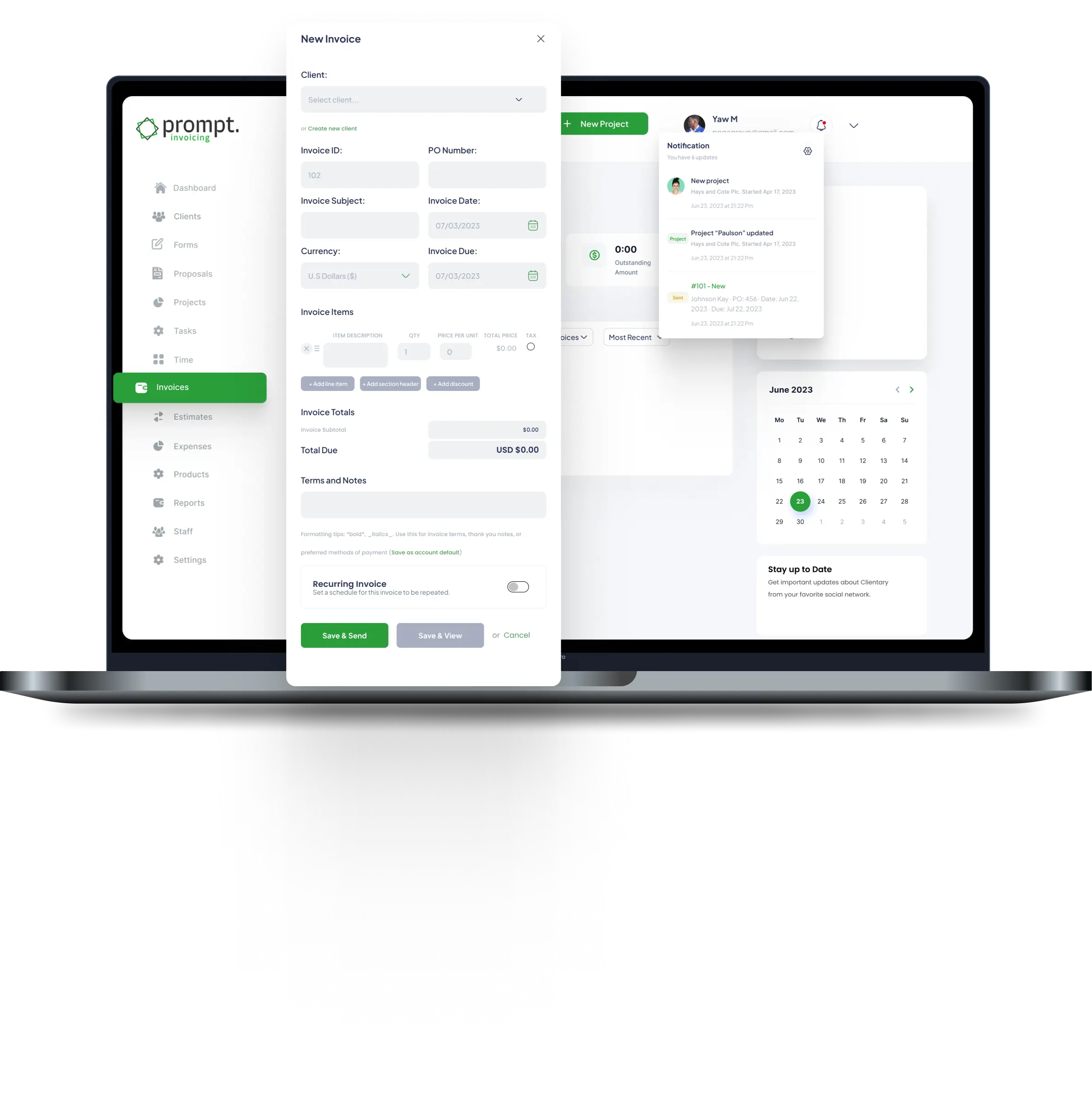
Prompt Integrated is a fully cloud-based platform — meaning your invoicing, expense tracking, payroll, and project management functions are accessible from any device, anywhere, at any time. A power cut at your premises does not stop your business from functioning.
Back up your data regularly
Whether or not power disruptions are a concern, backing up your business data regularly is essential. But in Ghana’s power environment, it becomes even more critical — because sudden outages can cause data loss if work is in progress when the power cuts out.
Cloud-based storage solutions like Google Drive and Dropbox automatically back up your documents and files online, so you never need to worry about losing important business records due to a power cut. Accounting records, payroll data, client contracts, and financial reports stored in the cloud are accessible even if a local computer fails entirely.
It is also good practice to maintain a physical backup on an external hard drive for situations where you need to access information without an internet connection.
Invest in backup power solutions
For businesses that simply cannot afford to stop operating when the power goes out, investing in backup power is not optional — it is a necessity.
UPS (Uninterruptible Power Supply). A UPS provides immediate backup power for a short period when the main supply cuts out, giving your team enough time to save their work and safely shut down equipment. Even if you have a generator, a UPS is valuable because generators take a few moments to kick in — and those moments can be enough to lose unsaved work.
Power inverters. A backup inverter system can keep your routers, computers, and essential lighting running for several hours during a power cut — which should be enough to see you through most scheduled outage periods. For a small Ghanaian business operating on a tight budget, an inverter is often the most cost-effective first step toward power resilience.
Generators. A generator provides more substantial backup power for longer periods and can keep most of your business operations running during extended outages. Fuel costs are a consideration, but for businesses where downtime is directly and immediately expensive — a cold storage facility, a printing company, a restaurant — a generator pays for itself quickly.
Explore solar power as a long-term fix
For Ghanaian small businesses serious about eliminating power disruption as a business risk, solar power is increasingly the most practical and cost-effective long-term solution.
Ghana has abundant sunshine throughout the year, making solar energy a genuinely viable option for businesses of all sizes. A well-designed solar installation — with battery storage to cover periods of low sunlight or nighttime operation — can effectively eliminate dependence on the national grid for daily operations.
The upfront investment is higher than a generator or inverter, but the long-term economics are compelling: no fuel costs, significantly reduced electricity bills, minimal maintenance, and the operational reliability of knowing your business will keep running regardless of what is happening with the grid.
The Energy Commission of Ghana provides information on renewable energy options and approved service providers for businesses looking to explore solar installations. There are also a growing number of reputable solar installation companies operating across Ghana — particularly in Accra and Kumasi — offering flexible payment arrangements that make the transition more accessible for smaller businesses.
Several Ghanaian businesses have already made the switch and report that the impact on operational reliability — and on their electricity costs — has been transformative.
Protect your hardware from power surges
As if being without power for hours was not enough, outages also pose a risk to your equipment when the electricity returns. When power is restored, it often comes back with a surge that can damage computers, printers, routers, and other sensitive hardware beyond repair.
To protect your equipment, switch off and unplug all computers and relevant devices from the main power source as soon as the power goes out. Once the power has been restored and has been stable for a few minutes, you can safely reconnect and power back up.
Surge protectors — available from electronics retailers across Ghana — are a low-cost investment that provides an important layer of protection for your hardware. They are worth having in place even when power supply is stable.
Keep your mobile devices charged
In Ghana’s business environment, smartphones are essential business tools — used for mobile money transactions, WhatsApp communication with clients and suppliers, internet access, and as personal hotspots when fixed-line connectivity is disrupted.
But using your phone heavily during a power cut drains the battery quickly — and the last thing you need is to be left without a charged phone when communication matters most.
Power banks provide the backup power needed to keep your mobile devices running throughout the day during an outage. Keep them charged and ready, and recharge them as soon as power is restored. For a small, affordable investment, a power bank provides significant peace of mind during extended outages.
Get the right insurance cover
Power cuts can damage sensitive and expensive electronics through surges — and replacing that equipment is a cost that can seriously disrupt a small business’s finances.
While power disruptions themselves are generally not an insurable event, damage to equipment caused by power surges can often be covered under a business insurance policy. Not all insurers offer this cover as standard, so speak to your broker specifically about whether your current policy includes protection for surge-related damage — and under what conditions a claim would be successful.
Some insurers may require evidence that you have backup power measures in place before they will offer this cover, so implementing the solutions described in this article is both good operational practice and a condition of maintaining adequate insurance protection.
Final thoughts
Power disruptions in Ghana are an operational reality that small businesses cannot afford to ignore. But they do not have to be the end of the road. With the right continuity plan in place — backup power, cloud-based systems, flexible working arrangements, and good data practices — your business can maintain productivity, protect its revenue, and keep serving customers even when the grid lets you down.
The businesses that weather Ghana’s power challenges best are the ones that prepare before the outage happens, not the ones scrambling to respond after it does.
Prompt Integrated supports Ghanaian businesses in staying operational and organised — with cloud-based invoicing, expense tracking, payroll, and project management tools that keep working wherever your team is working from. Get started with Prompt Integrated today.










Leave A Comment