

May 28, 2026
article by the prompt team

There is a word that has become impossible to avoid in business conversations across Ghana and the rest of the world: disruption. You hear it in boardrooms in Accra. You read it in business journals. You feel it in the way markets shift, customer habits change, and the tools your business relied on last year suddenly feel outdated.
For managers on the ground in Ghana, the reality is straightforward: disruption is no longer a rare event that businesses have time to prepare for. It is constant, fast, and often arrives without warning. The real question is not whether your business will face disruption — it is whether you as a manager will be ready to lead through it when it comes.
Here’s what we’ll cover:
- Understanding disruption in today’s business environment
- Why many managers get it wrong
- Clear and consistent communication
- Fast and informed decision making
- Strong financial awareness
- Flexibility in operations
- Supporting and empowering your team
- Turning challenges into opportunities
- Practical steps managers can take today
- Final thoughts
Understanding disruption in today’s business environment
Business disruption comes from several directions simultaneously, and Ghana’s recent economic history illustrates each of them vividly.
Technology is perhaps the most visible driver. The rapid adoption of mobile money in Ghana — led by MTN MoMo and Vodafone Cash — fundamentally disrupted how millions of Ghanaians send money, pay bills, and access financial services. Businesses that adapted early gained a significant competitive edge. Those that clung to cash-only models found themselves increasingly out of step with customer expectations.
Market conditions are equally disruptive. Ghana’s economy has experienced significant volatility in recent years — from the cedi’s depreciation against major currencies to the debt restructuring process that affected businesses with exposure to government securities. According to the Bank of Ghana, these shifts required businesses across sectors to fundamentally rethink their financial planning and operational models.
Customer behaviour is the third major disruptor. The Ghana Statistical Service has documented significant shifts in consumer spending patterns, particularly among urban Ghanaian millennials who increasingly expect digital-first experiences, rapid delivery, and transparent communication from the businesses they patronise.
Unlike gradual change — which gives businesses time to adjust slowly — disruption demands an immediate response. This is precisely why the quality of management leadership during disruptive periods is so consequential.
Why many managers get it wrong
Understanding disruption intellectually is one thing. Responding to it effectively under pressure is another.
Many managers have been trained in structured, predictable environments where processes are stable and outcomes are relatively foreseeable. Disruption strips away that comfort entirely — and exposes management habits that work fine in normal conditions but become dangerous in volatile ones.
McKinsey & Company’s research on organisational resilience identifies decision paralysis — the tendency to delay action while waiting for perfect information — as one of the costliest management responses to disruption. In fast-moving situations, waiting too long to act is itself a decision, and usually a damaging one.
Poor communication is equally destructive. When managers go quiet during uncertain periods, the information vacuum fills with rumour, anxiety, and misalignment. Teams lose focus. Confidence erodes. The best people start considering their options elsewhere.
The third common failure is the instinct to defend existing systems rather than adapt them. Companies that resisted the shift to digital payments or e-commerce during the COVID-19 disruption found themselves at a severe disadvantage compared to competitors who adapted quickly — a pattern documented across Ghanaian SMEs by the Association of Ghana Industries in their post-pandemic business recovery reports.
1. Communicate clearly — even when you do not have all the answers
During disruption, silence is not neutral. It is actively harmful.
When employees do not hear from their managers, they fill the gap themselves — with speculation, anxiety, and assumptions that are almost always worse than the reality. Gallup’s State of the Global Workplace report consistently shows that manager communication quality is one of the strongest predictors of employee engagement, particularly during periods of uncertainty.
The discipline required here is to communicate regularly and honestly — not just when you have good news or complete answers. An honest acknowledgement that the situation is challenging, paired with a clear statement of what the team is doing about it and what is expected of everyone, is far more effective than silence punctuated by occasional formal updates.
In Ghana’s workplace culture, where relationships and trust are foundational to how teams function, this kind of open communication from leadership carries particular weight. The Ghana Employers Association has highlighted transparent manager communication as one of the key differentiators between organisations that retained talent during Ghana’s recent economic turbulence and those that experienced high turnover.
Practical communication habits worth building include weekly team updates that address current challenges, progress, and priorities. Direct, honest conversations with individual team members. And a genuine open-door approach that makes it safe for people to raise concerns before they become crises.
2. Make decisions faster — and base them on data
Waiting for the perfect moment or the complete picture before acting is a luxury that fast-moving situations rarely afford.
This does not mean acting recklessly. It means making the best possible decision with the information available right now — and being willing to adjust as new information emerges.
Deloitte’s research on decision-making in volatile environments shows that organisations with strong data visibility consistently make better and faster decisions during disruption than those relying on intuition or delayed reporting. The difference is not intelligence or experience — it is access to timely, accurate information.
For Ghanaian business owners and managers, this means investing in systems that give you real-time visibility into your numbers. What is your current cash position? Which expenses are running above budget? Which revenue streams are holding up and which are declining? Without clear answers to these questions, good decision-making is almost impossible.
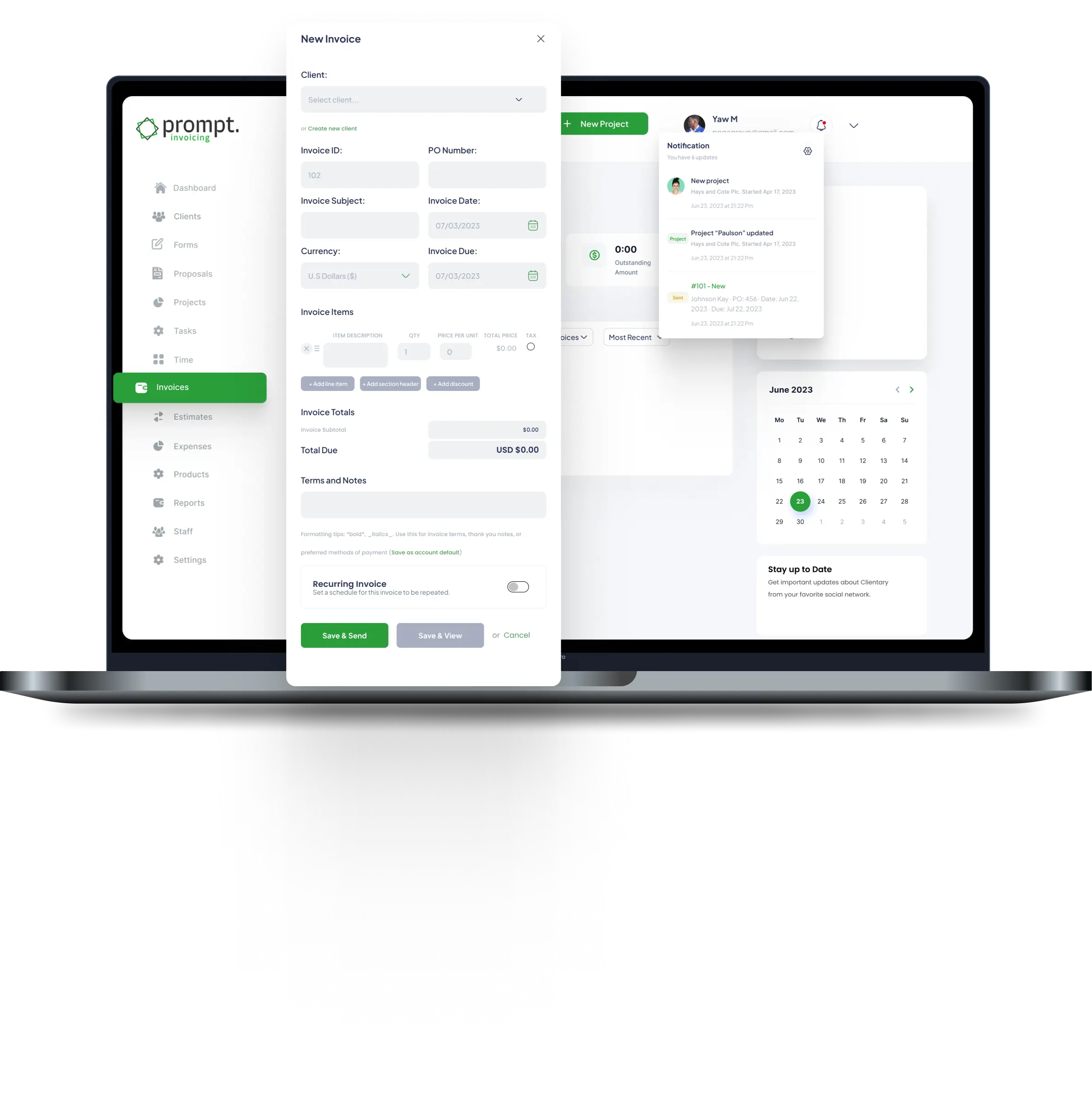
Prompt Integrated’s invoicing and expenses features give managers a real-time view of their financial position — so that when disruption demands a fast decision, the data needed to make it well is already available.
3. Stay close to your financial numbers
Disruption almost always affects revenue and costs simultaneously — and often in opposite directions. Revenue may decline as customers pull back. Costs may rise as supply chains tighten or the cedi weakens. Managers who are not closely monitoring their financial position can find themselves in serious trouble before they have even registered that something has gone wrong.
The Institute of Chartered Accountants Ghana emphasises that financial literacy among business managers is one of the most important factors in SME resilience during economic disruption. Their research on Ghanaian businesses that navigated the 2022 to 2023 economic crisis identifies cash flow monitoring and cost control as the two financial disciplines most strongly associated with business survival.
Managers should be tracking cash flow regularly during volatile periods, reviewing costs to identify and eliminate waste, and monitoring the ratio of receivables to revenue to ensure credit sales are not quietly draining liquidity.
Prompt Integrated’s payroll and expenses management features make this kind of financial discipline practical rather than burdensome — giving managers a clear, organised view of where money is going so that nothing critical gets missed.
4. Build flexibility into how your business operates
Rigid, inflexible organisations struggle during disruption because they are optimised for a specific set of conditions. When those conditions change, the rigidity that made them efficient becomes the very thing that makes them unable to respond.
Ghana’s most adaptable businesses during recent disruptions have demonstrated what genuine operational flexibility looks like in practice. Jumia Ghana pivoted its logistics model multiple times during the COVID-19 period to accommodate changes in consumer behaviour and movement restrictions. Kofa — a Ghanaian battery-swapping startup — built flexibility into its core business model by designing infrastructure that could scale up or down based on demand patterns that were inherently unpredictable in an emerging market.
For managers, building flexibility means regularly reviewing processes and asking honestly: is this still the most effective way to do this, or are we doing it this way because it is what we have always done? It means being willing to pilot new approaches, learn from what the data shows, and adjust without ego.
Prompt Integrated’s project management tools support this kind of operational flexibility by giving teams a clear, adaptable structure for managing tasks, deadlines, and responsibilities — one that can be adjusted quickly as priorities shift.
5. Support your team — they are your greatest asset during a crisis
Teams look to their managers during difficult periods in a way they simply do not during normal operations. The signal you send — through your words, your decisions, your composure, and the way you treat people when things are hard — shapes the culture of your organisation in lasting ways.
Harvard Business Review’s research on crisis leadership consistently identifies psychological safety — the belief that it is safe to speak up, raise concerns, and admit uncertainty — as the single most important team condition during periods of disruption. Managers who create that safety get better information from their teams, identify problems earlier, and maintain performance far more effectively than those who project false confidence or shut down dissent.
The African Management Initiative — a pan-African learning platform supporting thousands of managers across the continent — highlights team support and inclusive leadership as the two most impactful manager behaviours during economic and operational disruption.
Practically, this means holding regular check-ins that give team members space to raise concerns. Acknowledging when things are hard without dramatising it. And trusting your people with real information rather than managing them through uncertainty with vague reassurances.
6. Turn disruption into opportunity — because the best managers do
Disruption, for all the pressure it brings, consistently creates possibilities for businesses that are paying attention.
When markets shift, new gaps open. When established players struggle to adapt, space emerges for more agile competitors. When customer behaviour changes, new needs arise that the old market was not meeting.
Ghana’s business landscape offers compelling evidence of this. mPharma — a Ghanaian healthtech company — identified the disruption in pharmaceutical distribution across Africa as an opportunity to build a technology-enabled supply chain that serves both pharmacies and patients more effectively than the traditional model. They are now operating across multiple African countries.
Agrocenta — another Ghanaian startup — turned the disruption in agricultural market access into an opportunity to build a digital platform connecting smallholder farmers directly to buyers, eliminating the inefficiencies of the traditional supply chain.
Both of these businesses were built by managers who looked at disruption and asked not “how do we survive this?” but “what does this make possible?” That reframe — from threat to opportunity — is one of the most powerful shifts any manager can make.
Practical steps you can take starting today
Understanding the principles of leading through disruption is valuable. Translating them into action is what actually makes a difference.
Start by reviewing your current processes with honesty. Where are the bottlenecks? Which systems are slowing you down? Which habits made sense in a more stable environment but are now creating unnecessary friction?
Strengthen your financial visibility. If you do not have a clear, current picture of your cash flow, your expenses, and your revenue trends, fixing that is the single highest-priority action you can take. Prompt Integrated brings invoicing, payroll, expenses, and project management together in one platform — giving you the financial visibility that fast, informed decision-making requires.
Improve the quality and frequency of your communication with your team. Even a brief weekly update that acknowledges current challenges and clarifies priorities can significantly reduce anxiety and improve alignment.
Stay connected to Ghana’s business ecosystem for intelligence and support. The Ghana Chamber of Commerce and Industry and the Ghana Enterprises Agency both provide resources, networking, and advisory support specifically designed for Ghanaian SMEs navigating challenging business conditions.
Final thoughts
Disruption is not going away. If anything, the pace at which markets, technologies, and customer expectations are changing is accelerating — and managers who have not yet developed the habits and skills to lead through uncertainty will find that gap increasingly costly.
But the fundamentals of leading well through disruption are not mysterious. They are learnable, practicable habits — clear communication, data-informed decisions, financial discipline, operational flexibility, and genuine team support — that any manager willing to commit to them can develop.
As Peter Drucker, widely regarded as the father of modern management, observed: “The greatest danger in times of turbulence is not the turbulence itself, but to act with yesterday’s logic.”
The managers who will lead Ghana’s most successful businesses through the disruptions ahead are the ones willing to update their logic — to let go of what worked before when it no longer works, and to build the kind of adaptive, people-centred leadership that turns uncertainty into advantage.
Prompt Integrated is built to support that journey — giving Ghanaian managers and business owners the operational tools they need to stay financially clear, administratively efficient, and focused on what matters most. Get started with Prompt Integrated today.










Leave A Comment