

May 25, 2026
article by the prompt team

If you are running a business in Ghana right now, you already know that inflation is not just a headline — it is something you feel every single week. In the cost of your supplies. In your electricity bill. In the way your customers hesitate a little longer before making a purchase. In the gap between what you charge and what it actually costs you to deliver.
Ghana has made meaningful progress on inflation in recent times. According to data from the Bank of Ghana, headline inflation has eased considerably from its peak, with recent figures placing it in the single digits — a significant improvement from the elevated levels that squeezed businesses hard in 2022 and 2023. But easing inflation does not mean the pressure is gone. Operating costs remain high, the cedi continues to face depreciation pressure against major currencies, and utility and fuel costs can shift quickly.
The businesses that come through periods of economic volatility strongest are not the ones that simply hope things improve. They are the ones that take deliberate, practical steps to protect their margins, their cash flow, and their ability to keep trading — regardless of what the macroeconomic environment is doing.
This guide lays out five strategies that Ghanaian business owners can start implementing today.
Here’s what we’ll cover:
- Source locally to reduce currency exposure
- Price strategically and communicate openly
- Protect your cash flow and limit credit sales
- Digitise and streamline your operations
- Diversify your income streams
- Final thoughts
1. Source locally to reduce your exposure to currency risk
Ghana imports a significant volume of the raw materials and goods that businesses depend on. And every time the cedi weakens against the dollar or the pound — which it has done with painful regularity over the past decade — the cost of those imports goes up, often with very little warning.
For a business that buys its inputs in foreign currency and sells its products in cedis, this dynamic is one of the most damaging effects of inflation. Your costs rise immediately. Your ability to raise prices to compensate is limited by what your customers can actually afford.
The most direct way to reduce this exposure is to shift as much of your supply chain as possible to local sources.
Take a hard look at your current suppliers and identify every input that could realistically be sourced within Ghana. Raw materials from the Ashanti Region, agricultural produce from the Brong-Ahafo or Northern regions, packaging from Ghanaian manufacturers — every substitution you make reduces the percentage of your costs that are tied to exchange rate movements.
This is not always straightforward. Local sourcing sometimes comes with its own challenges around quality consistency and reliability. But the protection it offers against currency-driven cost spikes is real and significant.
The Association of Ghana Industries maintains an extensive network of local manufacturers and suppliers across sectors, and is a practical starting point for identifying domestic alternatives to imported inputs. The Ghana Export Promotion Authority is also worth engaging — particularly if your business has any export dimension, as they provide support for businesses building supply chains grounded in local production.
According to GhanaWeb, economists advising Ghanaian SMEs during high inflation periods have consistently highlighted local sourcing as one of the most effective structural defences available to small business owners.
2. Price strategically — and be honest with your customers about it
This is the conversation that most business owners dread, but avoiding it is one of the most costly mistakes you can make during an inflationary period.
Absorbing rising costs entirely — keeping your prices flat while your expenses climb — is not a sustainable strategy. It feels like good customer service in the short term. In reality, it is a slow erosion of the margins your business needs to survive, reinvest, and pay its people.
But there is a right way and a wrong way to approach pricing during inflation. Sweeping, sudden price increases with no explanation will lose you customers and damage trust that took years to build. What works far better is a transparent, deliberate approach.
Review your costs item by item rather than applying a blanket increase across everything. Understand exactly where your margins are being squeezed most severely and address those areas first. Where possible, move away from fixed printed price lists toward more flexible arrangements that can be updated without creating a sense of shock — digital menus, updated quotation templates, and regular client communications all help with this.
Most importantly, talk to your customers. Explain what is driving the change. Loyal customers — the ones who have been with you for years — are far more likely to accept a well-explained, reasonable price adjustment than a silent, unexplained increase. Transparency builds trust, and trust is what keeps people coming back even when times are hard.
The Ghana Report has documented how small businesses that communicated openly with their customers during inflation spikes fared significantly better in terms of retention than those that either absorbed costs silently or raised prices without explanation.
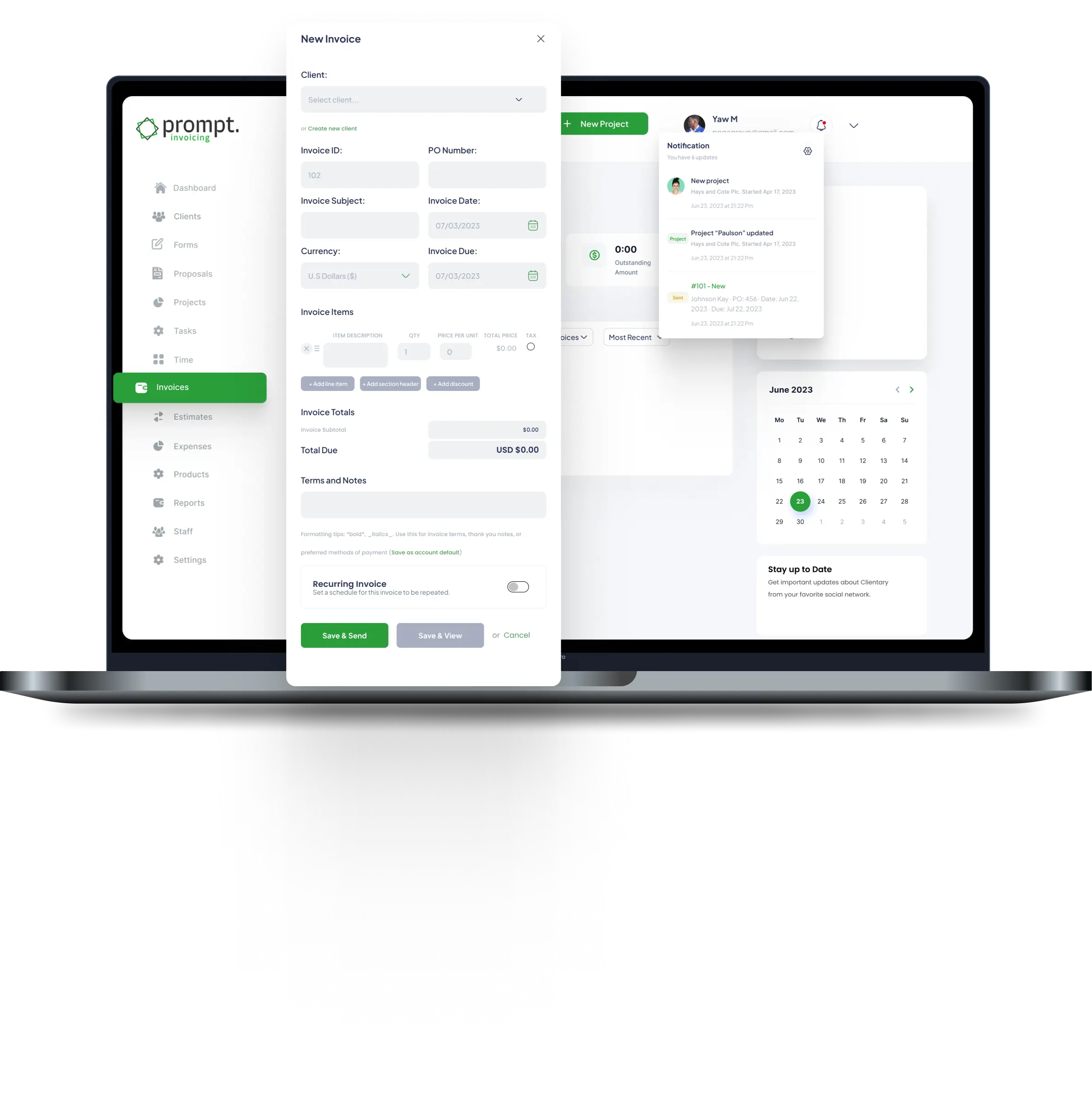
Keeping your pricing updated and your invoicing professional is also important during this process. Prompt Integrated’s invoicing feature makes it easy to update your pricing, generate accurate quotes and estimates, and send professional invoices to clients — so your billing always reflects your actual costs without creating administrative friction.
3. Guard your cash flow like it is your most valuable asset — because it is
During periods of inflation, the time value of money becomes very real, very fast. Every day that your revenue sits in an unpaid invoice rather than in your account is a day that money is quietly losing value. And every business that owes you money is effectively borrowing from you at no interest, while you absorb the inflationary cost.
Credit sales are a particularly dangerous habit during inflationary periods. The standard Ghanaian business practice of allowing customers to pay later — whether that is seven days, thirty days, or an informal arrangement that stretches much longer — can destroy your working capital position when costs are rising rapidly.
The discipline required here is straightforward but not always easy to apply: tighten your credit terms, enforce them consistently, and wherever possible, push for payment at the point of sale.
If eliminating credit sales entirely is not realistic for your business model, at minimum shorten your payment windows. Move from thirty days to fifteen. Offer a small discount for immediate payment — even a modest incentive can be enough to shift customer behaviour in a way that significantly improves your cash position. Implement credit checks for new customers before extending any terms.
GhanaWeb’s guide on managing inflation and protecting your finances highlights cash flow discipline as the single most important factor separating Ghanaian businesses that survived recent inflationary pressures from those that struggled or closed.
Prompt Integrated’s invoicing and expenses features give you real-time visibility into what has been invoiced, what has been paid, and what is outstanding — so you always know exactly where your cash position stands and can act quickly when something needs chasing.
4. Digitise your operations to cut overhead costs
When inflation pushes up the cost of everything — fuel, utilities, physical materials, transport — one of the most effective responses is to reduce your dependence on the things whose costs are rising fastest.
Digitisation does exactly that. Moving paper-based processes to cloud-based systems reduces the cost of physical materials and the time spent on manual administration. Encouraging remote or hybrid working where your business model allows it reduces fuel costs, office overheads, and the wear and tear on vehicles and equipment. Digitising your sales and customer communication reduces the cost of physical marketing materials and broadens your reach without a proportional increase in spend.
For a small business in Accra or Kumasi that is currently spending significant time and money on manual bookkeeping, physical invoicing, and in-person administrative processes, the shift to digital tools can produce meaningful cost savings relatively quickly.
Citi Newsroom has noted that Ghanaian businesses which embraced digital operations during previous inflationary periods were better positioned to manage overhead costs and maintain service quality than those that continued to rely on traditional, manual processes.
Prompt Integrated is built specifically for this transition. It brings invoicing, expense tracking, payroll management, and project management together in one cloud-based platform — replacing multiple manual processes with a single, affordable tool that saves time, reduces errors, and gives you a clear picture of your business finances at any given moment.
Ghana’s growing network of tech hubs, including MEST Africa in Accra, also provides resources and subsidised access to digital tools for early-stage businesses looking to make this transition.
5. Build multiple income streams so one slowdown does not sink you
A business that depends entirely on a single product, service, or customer segment is inherently fragile — and that fragility is most exposed during periods of inflation, when consumer spending patterns shift in ways that are difficult to predict.
When the cost of living rises and disposable income shrinks, customers make choices. They cut back on non-essentials. They switch to cheaper alternatives. They delay purchases they might otherwise have made without hesitation. If all of your revenue is concentrated in one area, a shift in that single area can threaten the entire business.
Diversification is the structural answer to this vulnerability. The goal is not to spread yourself so thin that you lose focus, but to build complementary revenue streams that serve different needs or different customer segments — so that if one area faces pressure, others can absorb the impact.
A catering business in Accra, for example, might add a cooking class offering or a meal prep delivery service alongside its core events catering. A fashion designer in Kumasi might introduce an online store targeting diaspora customers, adding a revenue stream that is less sensitive to local economic conditions. A consulting firm might develop a digital course or subscription service alongside its one-to-one client work.
Digital platforms have made this kind of diversification more accessible than it has ever been. Hubtel — one of Ghana’s leading digital commerce platforms — gives small businesses the tools to sell online, reach new customers, and build revenue streams that are not tied to physical location or foot traffic.
The Ghana Report’s analysis of SME survival during high inflation specifically highlights income diversification as one of the defining characteristics of businesses that maintained stability while others contracted.
Final thoughts
Inflation is one of those forces that you cannot control — but you can absolutely control how you respond to it.
The business owners who come through inflationary periods with their margins intact and their teams still in place are almost always the ones who acted early, made deliberate structural adjustments, and refused to simply hope that things would improve on their own.
Source more locally. Price more strategically. Tighten your cash flow. Digitise your operations. Build multiple streams of income. None of these steps is complicated in isolation. Together, they create a business that is genuinely more resilient — one that can absorb the shocks that come without losing its footing.
Stay informed about where Ghana’s economy is heading by following the Ghana Statistical Service for monthly Consumer Price Index updates and the Bank of Ghana for monetary policy developments. Knowledge of the macroeconomic environment is a genuine competitive advantage when most of your competitors are simply reacting to it after the fact.
And as you build that resilience, make sure the operational side of your business is working for you rather than against you. Prompt Integrated gives Ghanaian business owners a single platform to manage invoicing, expenses, payroll, and project management — so you always have a clear, accurate picture of your finances and can make the kind of informed, data-driven decisions that protect your business when economic conditions get tough. Get started with Prompt Integrated today.










Leave A Comment