

June 23, 2026
article by the prompt team

For a long time, many small business owners in Ghana assumed that serious technology was only for big companies with deep pockets. The kind of software that manages invoices automatically, tracks expenses in real time, runs payroll without spreadsheets, and keeps a whole team connected across different cities — that was for the corporates, not the entrepreneur running a fashion brand in Osu or a food distribution business in Tamale.
That assumption is no longer true. And the businesses that are figuring that out first are the ones pulling ahead.
Cloud technology has quietly changed the rules. What used to require expensive hardware, IT departments, and months of setup can now be accessed from a smartphone or laptop, set up in a day, and afforded by a business with a team of five. If you are running a small business in Ghana and you have not yet made the move to the cloud, this article will show you exactly what you are missing — and why now is the right time to act.
Here’s what we’ll cover:
- The playing field has changed — and cloud technology is why
- Solutions that work for the way Ghanaian businesses actually operate
- Real money saved by real businesses
- Your next great hire might not be in your city
- Why the unexpected does not have to derail your business
- Getting started is simpler than you think
- Final thoughts
The playing field has changed — and cloud technology is why
The gap between small businesses and large corporations has never been smaller — and cloud technology is the reason why.
In the past, the tools that allowed large companies to operate efficiently, serve clients professionally, and scale quickly were simply out of reach for most SMEs. The software was expensive. The infrastructure required was significant. The technical expertise needed to manage it all was a full-time job in itself.
Cloud solutions have dismantled most of those barriers. Today, a small business in East Legon with a team of five people can access the same quality of tools that a regional headquarters uses to manage hundreds of staff across multiple countries — at a fraction of the cost and without any of the infrastructure headaches.
“Cloud technology gives small businesses an affordable mechanism for managing their businesses and at the same time leveling the playing field,” says Andhra Pradesh, an IT consultant based in India.
Implementation no longer requires months of planning or a large upfront investment. Most cloud platforms can be set up quickly with minimal disruption to your daily operations — and the right ones are designed to be intuitive enough that your team can start using them with very little training.
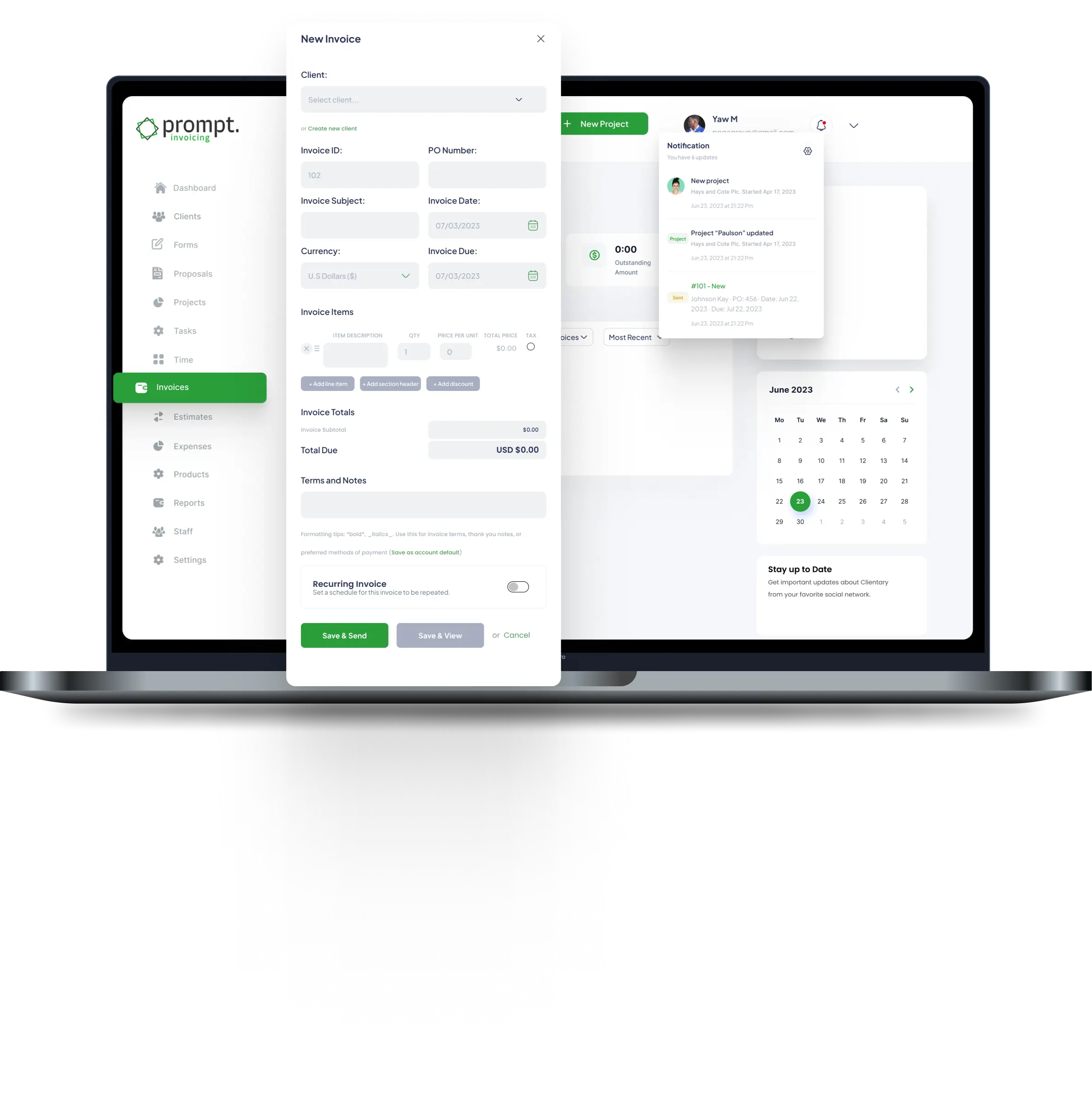
Prompt Integrated is built on exactly this principle — giving Ghanaian small businesses access to a full suite of professional business tools in one seamless platform. From proposals with e-signatures and project management to estimates, invoicing, expenses, tasks, payroll, and payments, everything your business needs to operate professionally is connected and accessible in one place, at a price that makes sense for a growing SME.
Solutions that work for the way Ghanaian businesses actually operate
Small businesses in Ghana do not operate in the same conditions as businesses in London or Singapore. Power supply can be inconsistent. Physical infrastructure varies significantly between regions. Many business owners and their teams need to move around — between offices, client sites, and home — and still stay on top of what is happening in the business.
Cloud technology is designed for exactly this kind of environment.
When your business systems live in the cloud rather than on a single computer or server in one location, your team can access everything they need from wherever they are — with just a smartphone and an internet connection. Whether you are checking on a project from Kumasi, approving an invoice from Takoradi, or running payroll from home during a power outage at the office, the work does not have to stop.
Beyond accessibility, cloud platforms consolidate the functions your business depends on — payroll, inventory, sales, accounting, project management — into one integrated system. There are no more paper trails to chase, no more uncertainty about who updated which version of a spreadsheet, and no more guessing about how your business is actually performing. You have a real-time view of everything, wherever you are.
And as your business grows, cloud systems grow with you. Whether you are taking on new staff, expanding into new regions, or managing the spike in demand that comes with festive seasons like Christmas or Eid, the system scales without you having to invest in new infrastructure.
Real money saved by real businesses
One of the most persistent myths about digital transformation is that it costs more than it saves. For cloud technology, the opposite is almost always true.
Consider what cloud adoption actually removes from your cost base. Instead of investing in expensive computers and servers for everyone on your team, staff can use their own devices. Office space requirements shrink because hybrid and remote work become genuinely practical — and lower office square footage means lower rent and lower utility bills. And because cloud platforms are maintained and updated by the provider rather than your own team, you are not carrying the cost of an internal IT function.
Esther, owner of Queen Foods International in Kumasi, saw this firsthand after moving her business to a cloud-based management system. Her operational costs came down noticeably within months — particularly in electricity and printing — and the time her team previously spent on manual administrative work was redirected toward serving customers and growing the business. Her experience reflects a broader pattern: businesses that make the shift to cloud-based operations consistently find that the savings materialise faster than expected.
There is also a sustainability dimension worth noting. Cloud infrastructure typically uses less energy per unit of computing power than on-premise alternatives — a consideration that is becoming increasingly relevant for Ghanaian businesses that are conscious of their environmental footprint.
Your next great hire might not be in your city
Not long ago, building a team meant being limited to candidates who lived close enough to commute to your office. That constraint shaped hiring decisions in ways that were not always in the best interest of the business — particularly for SMEs in Ghana’s larger cities, where traffic and commuting costs are a genuine deterrent for talented candidates.
Cloud technology has changed that entirely.
With the right tools in place, your business can collaborate effectively with team members across Ghana — from Accra and Tema to Ho, Sunyani, and Tamale — and even with contractors and partners beyond Ghana’s borders. Collaboration platforms like Google Workspace and Microsoft Teams make communication, file sharing, and remote meetings straightforward. And when your core business operations — invoicing, payroll, project tracking, expense management — all live in one cloud-based platform, your team has everything they need to work productively from wherever they are.
This is not just a convenience. It is a genuine competitive advantage. Businesses that can attract talent based on skill rather than proximity build stronger teams — and stronger teams build better businesses.
Why the unexpected does not have to derail your business
Every business faces unexpected disruptions. Flooding. Hardware failure. A power surge that wipes out a computer. A security incident that compromises locally stored data. For a small business where everything is stored on one machine or in one filing cabinet, any of these events can cause serious, sometimes irreversible damage.
Cloud technology fundamentally changes your resilience posture. When your data is stored in the cloud, it is automatically backed up and protected — meaning that even if something goes wrong physically at your location, your business information is safe and your operations can continue with minimal disruption.
For small Ghanaian businesses, where even a brief period of downtime can lead to lost clients, missed payments, and reputational damage that takes months to repair, this kind of built-in resilience is not a nice-to-have. It is a business necessity.
The Cyber Security Authority of Ghana consistently advises businesses to move away from locally stored data and toward cloud-based systems with proper encryption and backup protocols — guidance that aligns directly with what cloud adoption offers.
Getting started is simpler than you think
The idea of moving your business to the cloud can feel daunting if you have never done it before. But in practice, it is simpler than most people expect.
Setting up a cloud-based business management platform is, in many cases, easier and faster than registering your business with the Registrar General’s Department. Most platforms offer user-friendly onboarding, clear guidance, and support to get you started confidently — without requiring any technical background.
The key is choosing a platform that is built for the way Ghanaian businesses actually operate. Prompt Integrated was designed with exactly that in mind. Its full-cycle business management system connects proposals with e-signatures, project management, estimates, invoicing, expense tracking, task management, payroll, and payments in one seamless loop — at a price that is genuinely accessible for small and growing businesses in Ghana. You do not need to piece together five different tools or pay for enterprise software that is built for a different context entirely. Everything is in one place, working together from day one.
Final thoughts
Ghanaian small businesses have more opportunity to grow, compete, and scale than at any previous point in history. Cloud technology is a significant part of why that is true — and the businesses that embrace it now are the ones that will be best positioned to take advantage of everything that opportunity offers.
Moving to the cloud means lower operational costs, greater flexibility, real-time visibility into your business performance, access to a wider talent pool, and the confidence that your business data is protected and your operations can continue even when the unexpected happens.
The businesses winning in Ghana today are not waiting for the right moment to go digital. They are already there — and the gap between them and everyone else is growing every day.










Leave A Comment