

July 08, 2026
article by the prompt team

Every growing business in Ghana reaches a point where managing customer relationships from memory, WhatsApp chats, and scattered spreadsheets simply stops working. Leads fall through the cracks. Follow-ups get forgotten. Your team is not always sure what was promised to which client, or when. And the bigger your customer base grows, the worse the problem becomes.
This is the problem that CRM software was built to solve — and for small businesses in Ghana, getting it right can be the difference between a business that grows confidently and one that stays stuck managing the same chaos month after month.
CRM software replaces the outdated systems most small businesses rely on — the notebooks, the spreadsheets, the WhatsApp groups — with one organised, accessible platform that keeps your customer relationships, your communication history, and your sales activity in one place. The result is a business that serves customers better, markets more effectively, sells more consistently, and operates with far less internal friction.
This article explores the main benefits of CRM software for Ghanaian SMEs and how it can fundamentally change the way they operate.
Here’s what we’ll cover:
- Getting to grips with what CRM really means
- The case for bringing CRM into your business
- Give your customers a reason to keep coming back
- Make your marketing work harder with better customer data
- Stop wasting time on tasks your software can handle
- Close more deals with the right information at the right time
- Keep your whole team on the same page
- Turn one-time buyers into long-term supporters
- Free your team from repetitive work that slows them down
- Taking the first step — and where it can take your business
Getting to grips with what CRM really means
CRM stands for Customer Relationship Management. At its simplest, CRM software is a tool that helps businesses manage their interactions with current and potential customers in one organised, accessible place.
It centralises customer data — contact details, communication history, social media activity, transaction records, and individual preferences — making it significantly easier for businesses to track, manage, and analyse every customer interaction. Rather than hunting through old messages, notebooks, or spreadsheets to find what was discussed with a client six months ago, the information is right there, instantly accessible to anyone on your team who needs it.
For a small business in Ghana managing relationships with dozens or hundreds of customers simultaneously, this kind of organised visibility is genuinely transformative.
The case for bringing CRM into your business
The goal of CRM software is straightforward: strengthen your business relationships and improve profitability by keeping your business closely connected with customers and making your internal processes run more smoothly.
Implementing a CRM system gives you clearer insight into each customer’s value to your business — what they buy, how often, how much they spend, and what they are most likely to need next. That insight allows you to serve them better, which in turn drives higher sales and sustainable business growth.
Here are the specific ways a CRM delivers those benefits.
1. Give your customers a reason to keep coming back
Building strong customer relationships is one of the most important foundations of long-term business success in Ghana. Customers who feel well-served come back, refer others, and become the kind of loyal base that sustains a business through difficult periods.
A CRM system improves customer service by centralising all customer information and making it instantly accessible to everyone who needs it. When a customer calls with a question or a complaint, your team does not have to search through old WhatsApp threads or ask a colleague what happened last time — the full history is already there.
This results in faster responses, fewer complaints, and more positive experiences. Every customer interaction becomes an opportunity to increase satisfaction rather than a scramble to piece together context.
2. Make your marketing work harder with better customer data
One of the most powerful benefits of CRM for small businesses in Ghana is what it does for your marketing. When you understand your customers clearly — what they buy, when they buy, and what matters to them — you can create marketing that speaks directly to their needs rather than broadcasting generic messages and hoping something lands.
A CRM system enables a personalised approach to communication. Instead of sending the same message to your entire customer list, you can segment by purchase history, location, spending level, or any other relevant factor — and tailor your message accordingly. This kind of targeted marketing consistently outperforms broad campaigns, both in engagement and in return on investment.
It also helps you develop new products and services that align with what your customers are actually asking for, rather than what you assume they want.
3. Stop wasting time on tasks your software can handle
One of the most time-consuming aspects of running a small business is the administrative work that surrounds customer management — logging interactions, updating records, following up on leads, and keeping information current across multiple systems.
CRM software minimises the time your team spends on these tasks by automating the repetitive ones. Data entry that previously required manual input happens automatically. Follow-up reminders are triggered without anyone having to set them. Records are updated in real time without a separate administrative step.
This automation does more than save time. It also reduces the human errors that are inevitable in manual data management — wrong figures, missed updates, forgotten follow-ups — resulting in more reliable, consistent information across your entire customer base.
4. Close more deals with the right information at the right time
A CRM system can significantly increase sales by making your sales process both more efficient and more effective.
By centralising all customer information in one place, CRM gives your sales team a comprehensive view of each customer’s history, preferences, and previous interactions. This means that when a sales conversation happens, it is informed by real knowledge of the customer rather than a cold start. Sales representatives can tailor their approach, communicate more personally, and identify the right moment to make an offer.
The result is a sales process that converts more opportunities into actual revenue — and does so in a way that feels natural and responsive to the customer rather than transactional.
5. Keep your whole team on the same page
In many small Ghanaian businesses, information about customers lives in the heads of individual team members rather than in a shared system. When that person is unavailable, the knowledge is unavailable too — which creates gaps in service and missed opportunities.
CRM software solves this by making customer information accessible to everyone on your team who needs it. With just a few clicks, information can be shared between departments — ensuring that sales, customer service, and operations are all working from the same picture.
When everyone is informed and aligned, the customer experience improves significantly. Fewer things fall through the cracks. Fewer customers have to repeat themselves. And the whole business operates with greater coherence and less internal friction.
6. Turn one-time buyers into long-term supporters
For small businesses in Ghana, selling to an existing customer is almost always easier — and cheaper — than finding a new one. The relationship is already established. The trust is already there. The customer already knows what you offer and has chosen to buy from you before.
CRM systems play a crucial role in building and maintaining that loyalty. By giving every member of your team access to detailed customer interaction data, CRM enables more personalised service — the kind that makes customers feel known and valued rather than like just another transaction.
CRM technology also helps businesses manage renewals and keep track of at-risk accounts — identifying customers who may be drifting toward a competitor before they actually leave. This proactive approach to retention leads to a stronger, more stable customer base over time.
7. Free your team from repetitive work that slows them down
Beyond administrative work, CRM solutions automate a wide range of repetitive tasks that would otherwise consume significant amounts of your team’s time and attention.
A marketing professional can use CRM to send personalised emails about an upcoming promotion to thousands of customers simultaneously — segmented by location, purchase history, or any other relevant factor — without manually composing each message. Lead qualification processes can be automated so that your sales team is always focused on the prospects most likely to convert, rather than working through unqualified lists.
In Ghana’s competitive business environment, where every hour of your team’s time has real commercial value, this kind of automation is not just convenient — it is a genuine competitive advantage.
Taking the first step — and where it can take your business
CRM software is no longer something that only large corporations with dedicated IT departments can benefit from. For small businesses in Ghana, it is a practical, affordable tool that can change the way you manage customer relationships, run your marketing, support your sales team, and build the kind of loyalty that sustains long-term growth.
The businesses that invest in understanding their customers — and in building systems that keep that understanding organised and accessible — are the ones that consistently outperform those that rely on memory, spreadsheets, and scattered WhatsApp threads.
The best way to understand what CRM software can do for your business is to experience it within your own operations. You do not need to overhaul everything at once. Start with the basics — centralising your customer data, automating your follow-ups, and getting a clear view of who owes you what and where each relationship stands — and build from there.
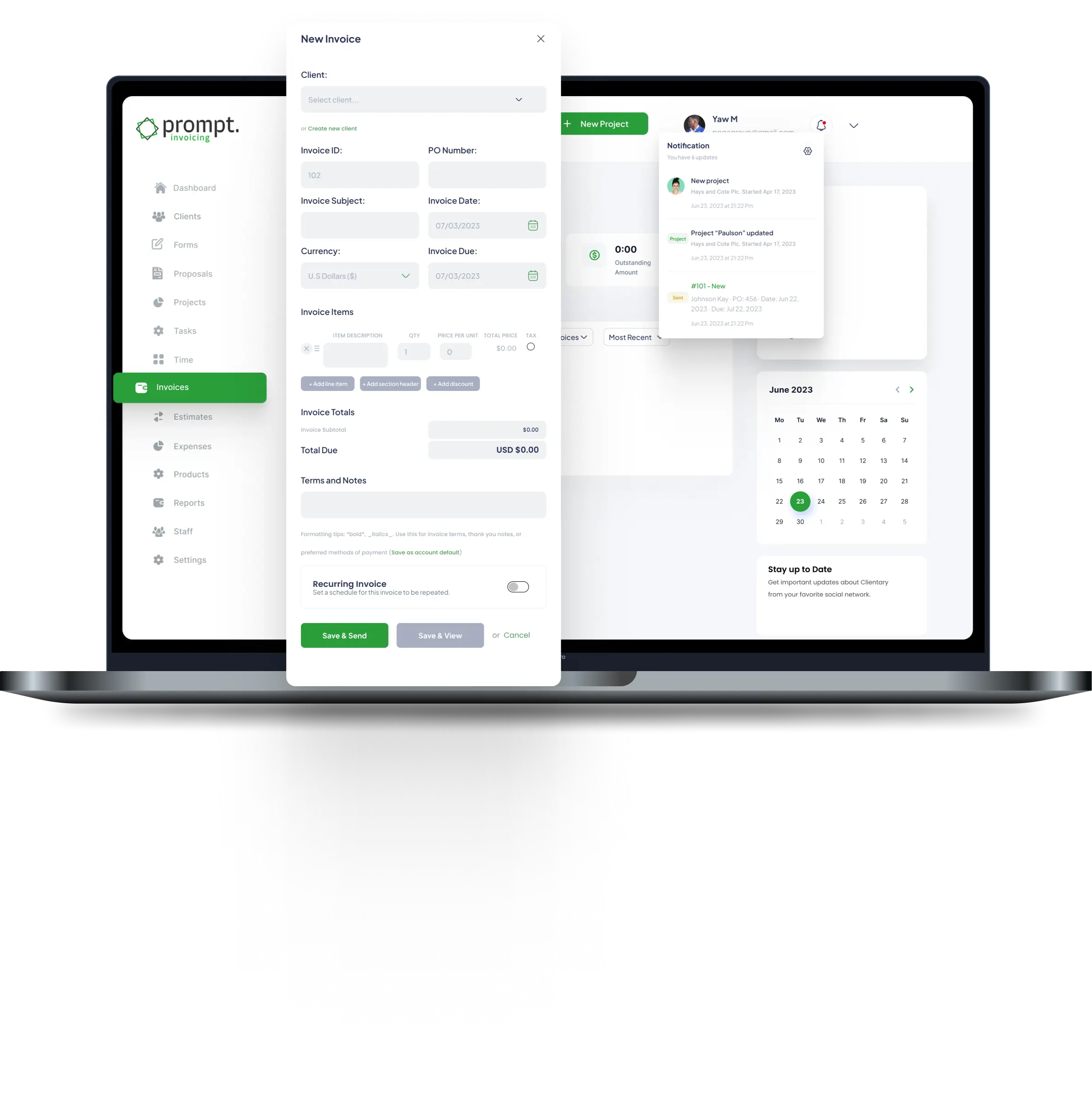
Prompt Integrated is designed to help Ghanaian small businesses do exactly that. It manages customer relationships, streamlines operations, and supports sustainable growth — all from one platform that also brings invoicing, expense tracking, payroll, and project management together in a single seamless system built for the way business works here.
When your customers feel known, your team is aligned, and your operations run without unnecessary friction, growth stops being something you chase and starts being something that happens naturally. Get started with Prompt Integrated today.






Leave A Comment