

August 20, 2026
article by the prompt team

Starting a business in Ghana as a sole proprietor is one of the most straightforward paths available to an aspiring entrepreneur. It is affordable to register, simple to administer, and gets you operating quickly without the complexity of more formal business structures.
But behind that simplicity lie real risks — particularly around personal financial liability, tax obligations, and the absence of certain protections that employees and more formally structured businesses take for granted.
If you are considering registering as a sole proprietor in Ghana, understanding both sides of that decision is essential. This guide walks through the key advantages and disadvantages so you can make an informed choice about the right structure for your business.
Here’s what we’ll cover:
- What is a sole proprietorship in Ghana?
- 3 advantages of sole proprietorships
- 3 disadvantages of sole proprietorships
- Final thoughts
What is a sole proprietorship in Ghana?
A sole proprietorship — sometimes called a sole trader — is the simplest form of business ownership in Ghana. It is a business owned and operated by a single individual, with no legal distinction between the owner and the business itself.
In Ghana, sole proprietorships are registered through the Registrar General’s Department (RGD), which has made the process increasingly accessible through its online registration portal. Registration is relatively affordable and can be completed in a matter of days, making it the most popular starting point for first-time entrepreneurs across the country.
3 advantages of sole proprietorships
1. It is simple to set up and run
A sole proprietorship has fewer formal requirements than other business structures in Ghana. There is no minimum share capital, no board of directors to appoint, and no complex governance structure to maintain.
You are the decision-maker. You set your own direction, manage your own finances, and withdraw from your business income as your needs require. For an individual starting a small service business, a freelance operation, or a retail venture, this freedom and simplicity is a genuine advantage — particularly in the early stages when flexibility matters more than structure.
The registration process itself is straightforward. Through the RGD’s online portal, sole proprietorships can be registered relatively quickly and at a fraction of the cost of registering a limited liability company.
2. You can be up and running quickly
Once you have made the decision to start your business, a sole proprietorship allows you to move from plan to operation faster than any other formal business structure.
Preparing a clear business plan is still time well spent — it sharpens your thinking, clarifies your financial projections, and gives you a roadmap for the months ahead. But once that preparation is done, the registration process does not need to be a barrier. Many Ghanaian entrepreneurs register their sole proprietorships and begin trading within the same week.
For someone with a specific skill, a product idea, or a service to offer — a seamstress in Kumasi, a caterer in Accra, a freelance designer in Takoradi — this speed to market is a meaningful advantage.
3. It is the most affordable business structure to register
Registering as a sole proprietor in Ghana is significantly cheaper than establishing a limited liability company. There is no minimum share capital requirement, no mandatory audit, and the ongoing administrative obligations are less burdensome than those of more complex business structures.
For first-time entrepreneurs who are starting with limited capital and testing a business concept, this affordability reduces the financial risk of formalising the business — which is always better than operating informally.
3 disadvantages of sole proprietorships
1. You carry the full personal financial risk
This is the most significant disadvantage of a sole proprietorship — and it is one that many new entrepreneurs do not fully appreciate until it becomes a problem.
As a sole proprietor, there is no legal separation between you as an individual and your business. If your business accumulates debts — to suppliers, to clients, to the Ghana Revenue Authority — you are personally liable for those debts. That means creditors can legally pursue your personal assets — your savings, your vehicle, even your property — to recover what is owed.
This is fundamentally different from a limited liability company, where the owner’s personal assets are generally protected from business debts.
Because the financial consequences of business failure can be so personal and far-reaching for a sole proprietor, this structure is generally most appropriate when the business can operate with limited financial obligations, few employees, and manageable risk levels.
Keeping your business and personal finances completely separate — from the very beginning — is one of the most important financial disciplines for any sole proprietor.
Choosing to operate as a sole proprietor means stepping outside the safety net that conventional employment provides. There is no employer paying into your social security on your behalf in the same way. There is no sick pay from day one. There is no unemployment benefit if business dries up.
In Ghana, SSNIT contributions are a key component of long-term financial security — covering retirement benefits, invalidity cover, and survivors’ benefits. As a sole proprietor, making consistent voluntary contributions to SSNIT is your own responsibility — and one that is easy to deprioritise when business is busy or cash flow is tight.
It is also worth considering income protection insurance or other forms of cover that can provide a financial buffer if illness, injury, or an unexpected personal event prevents you from working. For a business where everything depends on a single individual, any disruption to that individual’s capacity to work has an immediate and direct impact on revenue.
3. All profit is taxed as personal income
In a sole proprietorship, there is no distinction between the business’s profit and your personal income — they are the same thing. Whatever your business earns, after expenses, is treated as your personal income for tax purposes by the Ghana Revenue Authority.
This creates a specific challenge when you want to reinvest profit back into the business. In a limited liability company, retained earnings kept within the business are treated differently from income paid out to the owner. In a sole proprietorship, that distinction does not exist — which means you may pay income tax on money you are not actually spending personally, simply because it is sitting in the business.
Understanding your tax obligations as a sole proprietor — including PAYE on any staff you employ, VAT registration thresholds, and your personal income tax rate — is important from the earliest stage of your business. The Ghana Revenue Authority’s online portal provides resources and filing tools for sole traders, and engaging with a qualified accountant who understands Ghana’s tax framework for self-employed individuals is a worthwhile investment.
Keeping your financial records accurate and up to date throughout the year makes tax filing significantly less stressful.
Final thoughts
A sole proprietorship is a practical, accessible, and affordable starting point for many Ghanaian entrepreneurs. It is fast to register, simple to operate, and gives you complete control over your business and your time.
But it is not without its risks. Personal financial liability, the absence of employment protections, and the way profit is taxed are all real considerations that can have significant consequences if they are not understood and planned for from the beginning.
Whether a sole proprietorship is the right structure for your business depends on the nature of what you are building, the level of financial risk involved, and your long-term goals as an entrepreneur. If you are unsure, speaking to a qualified business advisor or accountant — ideally one familiar with Ghana’s business registration and tax environment — is a valuable first step.
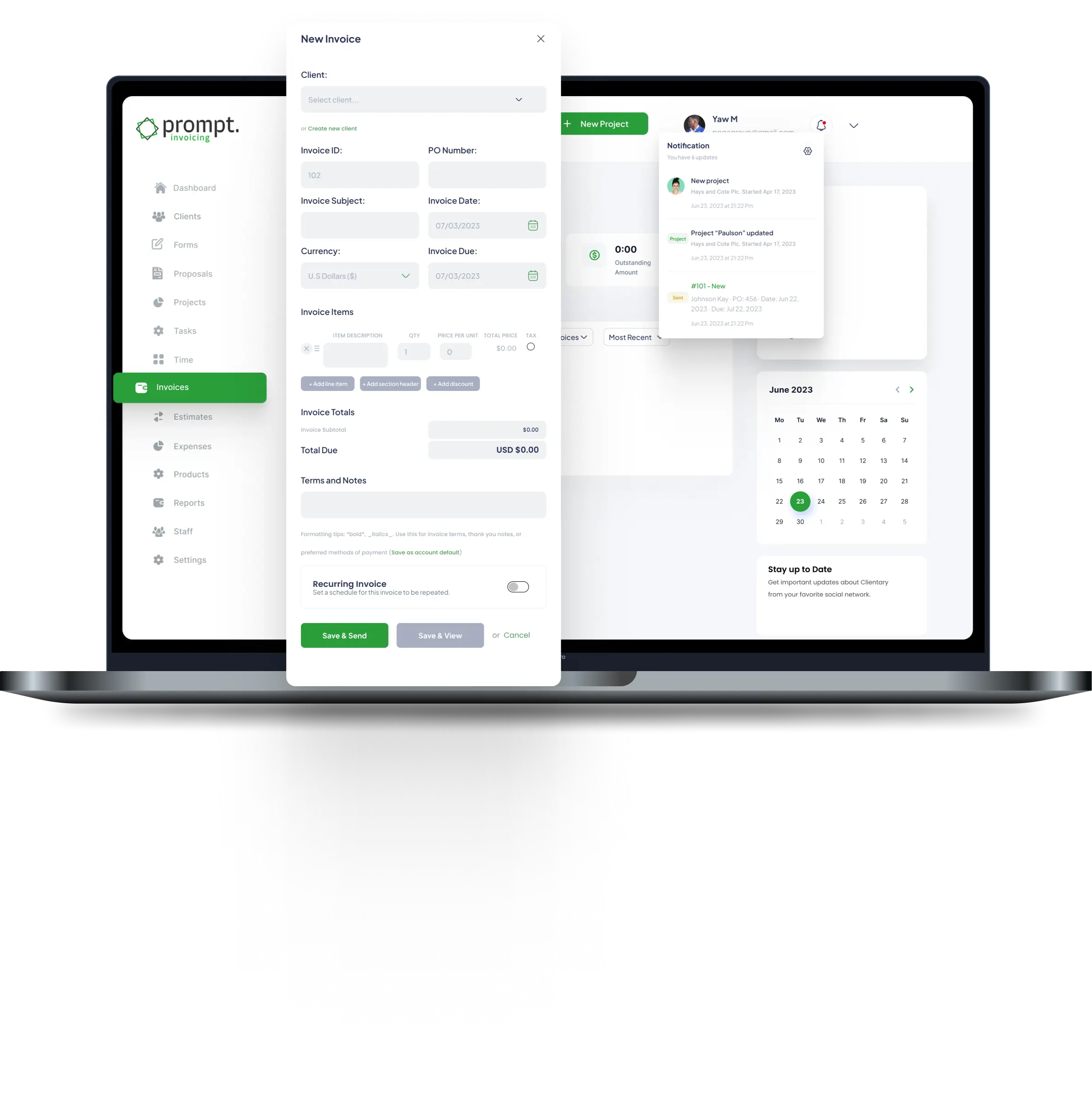
And whatever structure you choose, starting with good financial habits from day one gives your business the foundation it needs to grow sustainably. Prompt Integrated gives Ghanaian sole proprietors a simple, affordable platform to manage their invoicing, expenses, payroll, and projects professionally from day one — so your business looks and operates like a serious operation from the very beginning. Get started with Prompt Integrated today.









Leave A Comment