

July 20, 2026
article by the prompt team
If you run a small business in Ghana, you already know that the value of the cedi is not something you can control — but it is something you feel constantly. When the cedi weakens against the dollar or the pound, the cost of imported goods goes up. Your suppliers charge more. Your margins shrink. And customers who are also feeling the pinch start looking for cheaper alternatives.
Currency volatility is a feature of Ghana’s economic environment, not a temporary exception to it. The cedi has experienced significant fluctuations over the years, and while the macroeconomic picture has improved in recent times, the underlying exposure remains real for any business that imports goods, pays for international services, or operates in a market where fuel and utility costs move with the exchange rate.
The good news is that while you cannot control the cedi, you can take deliberate steps to reduce your exposure to it — and even find opportunities in it. This guide explains how.
Here’s what we’ll cover:
- Understanding how cedi movements affect your business
- The opportunity for exporters
- The broader impact of a volatile cedi
- Steps to protect your business
- Final thoughts
Understanding how cedi movements affect your business
Before you can manage currency risk, you need to understand where it actually shows up in your business. As the cedi strengthens or weakens against major currencies, it will inevitably affect your profit margins — sometimes in ways that are not immediately obvious.
The most direct impact is on imported goods. When the cedi weakens, anything your business brings in from overseas becomes more expensive. When it strengthens, those costs come down. That much is straightforward. But the implications go further:
When the cedi weakens significantly, your imported products may become too expensive for your customers — particularly if local substitutes are available at a lower price point. Customers who have been buying from you may switch, and winning them back can be harder than keeping them in the first place.
If you have used credit to import goods from overseas suppliers, a sudden shift in the cedi’s value can catch you off guard — leaving you with a higher debt burden than you budgeted for when you placed the order.
On the other hand, if the cedi falls after you have already purchased and paid for stock, you may find yourself holding inventory that is now more expensive to replace — which can actually boost your revenue if you sell at current market prices, or allow you to undercut competitors who are restocking at the new, higher import cost.
The opportunity for exporters
A weakening cedi is not only a challenge. For businesses that export goods or services — or that invoice international clients in foreign currencies — it can be a significant opportunity.
When the cedi falls, revenue earned in dollars, pounds, or euros is worth more in cedi terms when it is converted. This means exporters can maintain or even grow their cedi-denominated income without necessarily increasing the prices they charge international clients. Meanwhile, costs like rent, utilities, and local labour are still paid in cedis — so the margin between international revenue and local costs can actually widen during periods of cedi weakness.
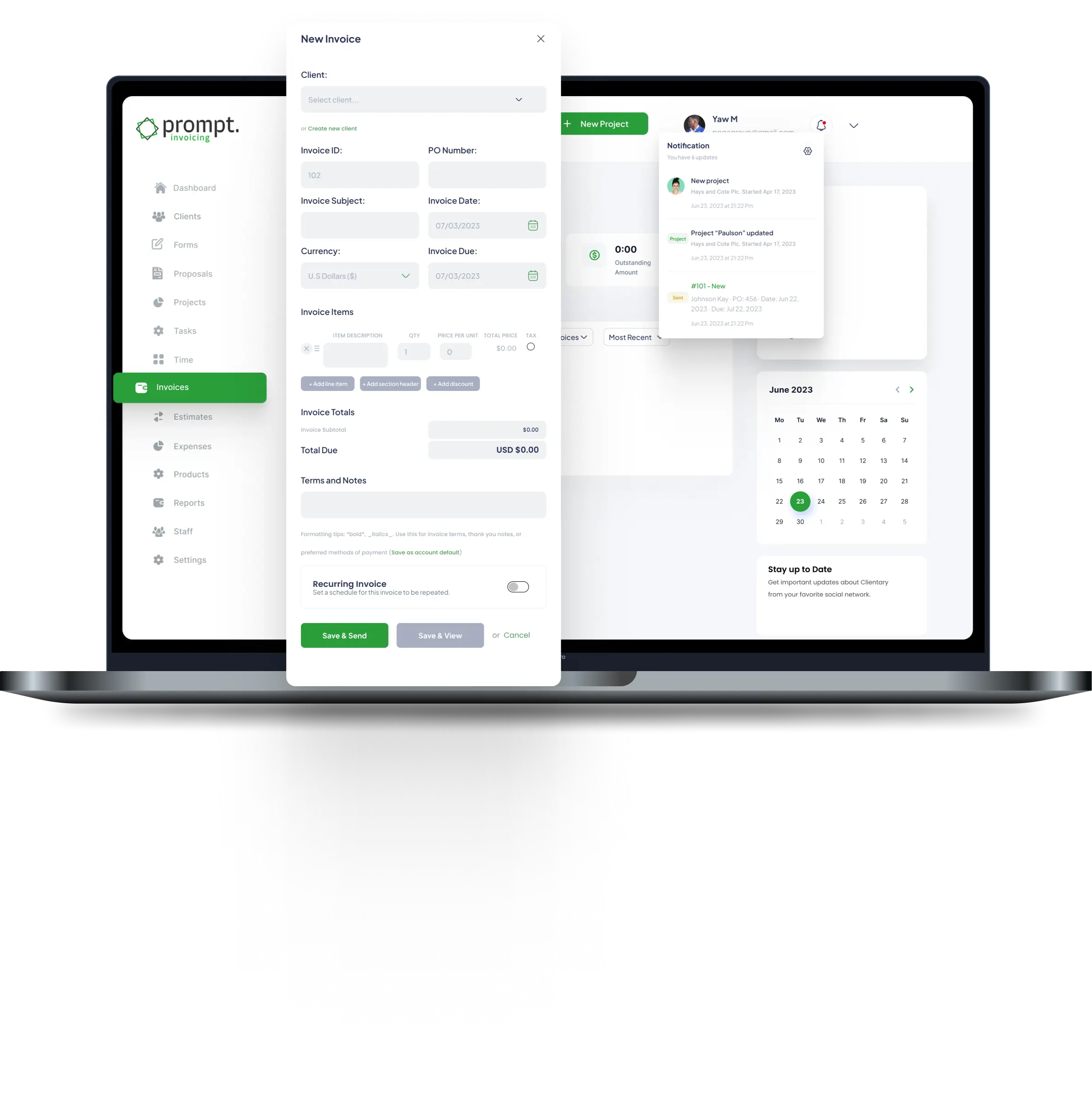
Ghana’s growing digital economy has made this opportunity more accessible than ever. Freelancers, consultants, creative professionals, and service businesses of all kinds can now earn in foreign currency by serving international clients — and tools like Prompt Integrated’s invoicing feature make it straightforward to invoice international clients professionally and track payments in multiple currencies.
However, a word of caution: businesses should not let their standards slip in response to a weaker cedi. If quality drops because the exchange rate makes it feel less necessary to maintain it, those habits will be difficult to reverse when the cedi eventually strengthens — and the reputational damage with international clients may be lasting. It is also important to account for international input costs like shipping, freight, and marketing when planning during periods of currency fluctuation. Ideally, your cash flow should be able to absorb fluctuations of ten to fifteen percent in the cedi’s value without causing serious operational disruption.
The broader impact of a volatile cedi
The effects of cedi volatility extend well beyond businesses that directly import or export. Even businesses that operate entirely within the Ghanaian market feel the pressure in several ways.
Equipment maintenance and replacement becomes significantly more expensive when the cedi weakens, particularly for businesses that depend on machinery or technology sourced from overseas. Spare parts, repairs, and replacements all carry a foreign currency component — and a weaker cedi makes every one of them more costly. Monthly subscriptions to international software and cloud services are also affected in the same way.
Fuel and utility costs tend to rise when the cedi weakens, because Ghana’s fuel pricing is tied to international oil markets priced in dollars. Higher fuel costs flow through the entire economy — increasing transport costs, raising the price of goods, and reducing the disposable income available to consumers. Larger businesses can absorb these increases. For smaller businesses already operating on tight margins, they can be genuinely damaging.
Consumer spending power shrinks when fuel and food prices rise. Customers cut back. Businesses that depend on discretionary spending feel that contraction directly in their revenue. And when smaller businesses suffer, the ripple effect on the broader local economy is significant.
Foreign investment can also be deterred by sustained currency volatility, as investors become more cautious about committing capital to markets where the return in their home currency is uncertain.
Steps to protect your business
Understanding how cedi volatility affects your specific business is the foundation for protecting yourself against it. Once you know where your exposure lies, you can put practical measures in place.
Consider currency hedging where possible. For businesses with predictable international payment obligations — annual software subscriptions, regular import orders, ongoing overseas service agreements — paying upfront or entering longer-term contracts at a fixed rate can protect you from the worst of a sudden cedi drop.
Choose the right payments provider. If your business accepts international payments by card or bank transfer, the provider you use matters. Look for one that offers competitive currency conversion rates and low transaction fees — because the difference between providers can meaningfully affect how much you actually receive after conversion.
Look for opportunities to increase exports. A weaker cedi is a signal to actively explore whether your products, services, or skills can be sold internationally. Ghanaian businesses in sectors like technology, creative services, agriprocessing, and professional services have real opportunities to build international revenue streams — and this is one of the most effective long-term hedges against domestic currency volatility. Organisations like the Ghana Export Promotion Authority provide support and guidance for businesses looking to expand into international markets.
Go local wherever you can. Every imported input you can replace with a quality local alternative reduces your exposure to cedi volatility. Review your supply chain regularly and identify substitutions that do not compromise the quality of your product or service. The Association of Ghana Industries is a useful resource for connecting with local suppliers across multiple sectors.
Final thoughts
Cedi volatility is a reality of doing business in Ghana. It always has been, and for the foreseeable future it always will be. But that does not mean your business is helpless in the face of it.
Understanding where your exposure lies, building cash flow resilience, diversifying your revenue, sourcing locally where possible, and using the right financial tools to maintain clear visibility into your numbers — these are all practical, achievable steps that any Ghanaian small business can take to reduce the impact of currency fluctuations and position itself to take advantage of the opportunities they sometimes create.
Currency volatility is not always a threat. For the business owner who is prepared, it can also be an edge.
Prompt Integrated gives Ghanaian businesses the financial clarity and operational organisation they need to navigate economic uncertainty with confidence — managing invoices, expenses, payroll, and projects from one platform built for the way business works here. Get started with Prompt Integrated today.








Leave A Comment