

May 18, 2026
article by the prompt team

Every manager reaches a point where they have to be honest with themselves about something uncomfortable: the people on their team are carrying more than they are showing.
In Ghana’s fast-moving business environment — where targets are ambitious, resources are often stretched, and the pressure to deliver never really lets up — workplace stress has become one of the most quietly damaging forces in any organisation. It does not always announce itself loudly. It shows up gradually, in missed deadlines, declining quality, shorter tempers, and eventually, in resignation letters from people you genuinely could not afford to lose.
The question is not whether your team experiences stress. They do. The real question is what kind of manager you are going to be in response to it. Because how you handle the pressure your people are under will determine not just how well they perform, but whether they stay, grow, and bring their best to the work that matters most.
This guide is written for managers who want to do better — not with grand gestures, but with the kind of consistent, practical, human-centred leadership that actually makes a difference.
Here’s what we’ll cover:
- Why workplace stress deserves your serious attention
- Acknowledge what your team is going through
- Draw a clear line between work time and personal time
- Build flexibility into how your team works
- Give your team one reliable place to find everything
- Cut back on meetings that drain more than they deliver
- Pair people up for mutual support
- Set expectations that reflect reality
- Final thoughts
Why workplace stress deserves your serious attention
It is tempting to treat stress as an unavoidable cost of doing business — something people simply have to manage on their own. But chronic, unaddressed stress has consequences that go well beyond the individual, and understanding those consequences is what makes taking action feel urgent rather than optional.
At the personal level, the physical impact of sustained stress is serious and well documented. The World Health Organization identifies workplace stress as a leading contributor to mental health conditions including anxiety and depression, and links it to physical health outcomes ranging from cardiovascular disease to compromised immune function. For employees already navigating the pressures of daily life in cities like Accra or Lagos — commutes, cost of living, family obligations — workplace stress does not exist in isolation. It stacks.
Beyond the human cost, there is a direct business cost. Research from Willis Towers Watson found that 57% of highly stressed employees report feeling less productive and less engaged at work. Stressed employees rush. They make more errors. They stop going the extra mile because they simply have nothing left to give.
And when it becomes too much, they leave. The African Development Bank has consistently highlighted employee wellbeing and retention as critical factors in building sustainable organisations across the continent. Replacing a skilled employee costs far more — in time, money, and lost knowledge — than addressing the conditions that made them want to leave.
Workplace stress is not a soft issue. It is a business issue. And it deserves to be treated as one.
1. Acknowledge what your team is going through
Before you implement any strategy or introduce any new system, do something simpler first: see your people.
When employees feel that the pressure they are carrying is invisible to those above them, it creates a particular kind of demoralisation that is hard to shake. They begin to feel like a number rather than a person — someone whose output is monitored but whose experience is irrelevant. That feeling does not just add to the stress. It multiplies it.
“The best thing to do first is to acknowledge the stress factors and the existing workload, and then appreciate the work each employee is doing to work toward the goal,” explains Nikita Lawrence, Senior HR Ops Liaison and Change Management Consultant.
Acknowledgement does not require a formal programme or a budget. It requires presence and sincerity. A genuine conversation. A meaningful thank you at the end of a tough week. Bringing in kelewele or meat pies on a Friday morning after a demanding project stretch. These small acts communicate something that matters deeply to people: that their effort has been noticed, and that it is valued.
The Ghana Employers Association has long emphasised recognition and appreciation as foundational elements of a healthy workplace culture — and the evidence consistently supports it. Employees who feel seen work harder, stay longer, and handle pressure more effectively than those who do not.
2. Draw a clear line between work time and personal time
There is a habit that many managers fall into without fully realising the damage it causes: reaching out to employees outside of working hours.
A quick WhatsApp message on a Sunday evening. An email fired off at midnight. A voice note sent during a public holiday. Each one feels trivial in the moment. Collectively, they erode something important — the employee’s ability to genuinely switch off, recover, and return to work the next day with their energy replenished.
Rest is not a luxury. It is a biological requirement for sustained performance. When employees cannot properly disconnect from work, their cognitive function, emotional resilience, and creative capacity all decline over time. You are not getting more from them by staying in touch around the clock. You are quietly depleting them.
The International Labour Organization’s Africa regional office has consistently advocated for clear boundaries between working and non-working hours as a fundamental component of worker wellbeing and productivity across the continent.
If you have a thought outside of hours that needs capturing, write it down and send it when the working day begins. If something genuinely cannot wait, be explicit that no immediate response is expected. Your team needs to know — and to feel — that their personal time is genuinely theirs.
3. Build flexibility into how your team works
Control over how and when work gets done is one of the most effective stress-reduction tools available to any manager — and it costs very little to offer.
“In managing employees and independent contractors, I have found that a flexible work environment has greatly helped high-stress employees. Many are juggling careers, families, and — more recently — aging parents,” explains Dr. Sarah Renee Langley, Leadership Coach, Licensed Professional Counselor, and Founder and CEO of LeadHer International.
In the Ghanaian context, this matters enormously. Accra’s traffic alone can add two to three hours to an employee’s day. For working parents managing school runs, or employees caring for elderly relatives, rigid nine-to-five arrangements can turn an already demanding job into something genuinely unsustainable.
Owl Labs’ research on remote and flexible working consistently shows that companies offering flexible arrangements experience significantly lower staff turnover — a finding that translates directly to the African business environment, where retaining skilled talent is increasingly competitive.
Flexibility does not have to mean full remote working. It might mean allowing employees to start earlier or finish later to avoid peak traffic. It might mean one work-from-home day per week, or the understanding that personal appointments can be accommodated without drama. The message it sends — that you trust your people and respect their lives outside work — is worth more than the logistical adjustment it requires.
4. Give your team one reliable place to find everything
Ask yourself honestly: how much of your team’s stress comes not from the actual work, but from the friction of navigating it? Hunting for the latest version of a document. Trying to remember which conversation happened in which channel. Not being sure who is responsible for what, or where a project currently stands.
For many teams, this kind of operational noise is a significant and entirely avoidable source of daily frustration. When information is scattered across emails, messaging apps, verbal conversations, and shared drives that nobody keeps properly organised, cognitive load increases and errors multiply — not because people are not capable, but because the systems are working against them.
A centralised work management platform changes that dynamic. It gives everyone a single, reliable source of truth — one place to find what they need, track progress, communicate, and stay aligned, whether they are in the office in East Legon or working remotely from Kumasi.
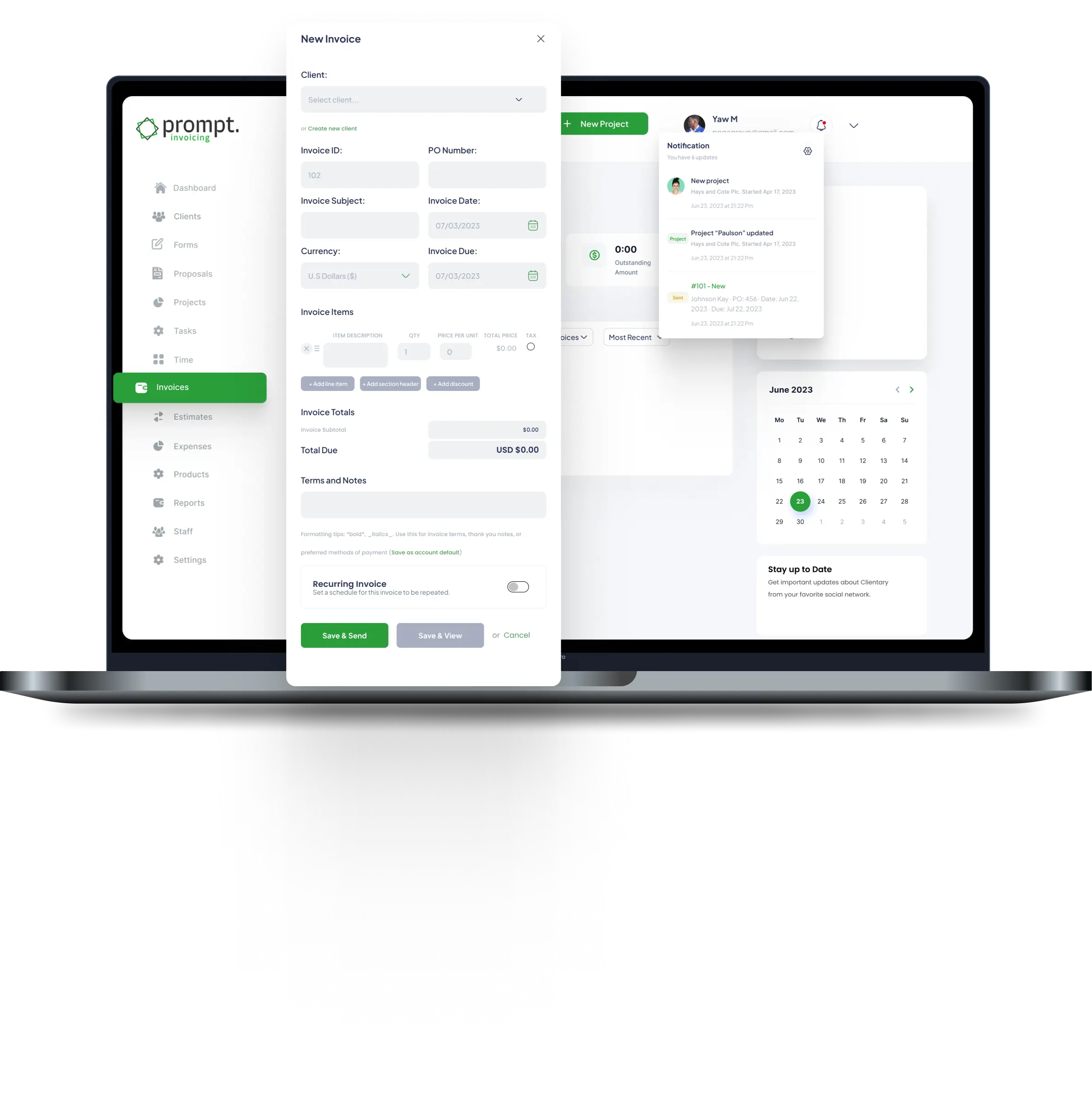
Prompt Integrated’s project management feature is built for exactly this — giving teams across Ghana and Africa a clear, organised view of tasks, deadlines, and responsibilities so that the administrative noise that quietly drains energy throughout the day is reduced to a minimum.
5. Cut back on meetings that drain more than they deliver
If your team consistently feels short on time despite working hard, meetings are almost certainly a significant part of the problem.
Harvard Business Review research has shown that executives now spend close to 23 hours per week in meetings on average — and that a large majority of those meetings are considered unproductive by the people attending them. The cost of this is not just time. It is the fragmentation of focus, the interruption of deep work, and the frustrating feeling of being perpetually busy without meaningfully advancing anything.
Take an honest look at your recurring meetings. Which ones genuinely require everyone in the room — or on the call? Which are effectively status updates that could be replaced by a brief written summary or a shared project board? Are there meetings that could be combined, shortened, or removed entirely without anyone being worse off?
Some organisations have gone as far as protecting certain days or time blocks from meetings entirely — creating space for focused, uninterrupted work. It is a simple intervention, and teams that try it almost universally report that it makes a meaningful difference to how productive and in-control they feel.
For the meetings that do need to happen, Dr. Langley offers a practical suggestion worth trying: “Some kind of physical activity is a good way to de-stress and redirect energy in a calmer manner.” A walking meeting, taken around the block or through a nearby green space, can shift the energy of a conversation in ways that a conference room rarely manages.
6. Pair people up for mutual support
Sometimes the most powerful support a stressed employee can receive does not come from their manager — it comes from a colleague who genuinely understands what they are going through.
Intentionally pairing newer or more overwhelmed team members with experienced colleagues is a simple strategy with a disproportionate impact. Not as a form of oversight, but as a genuine transfer of knowledge, perspective, and practical wisdom.
“Pair experienced workers with newer employees,” says Jacob Dayan, CEO and Co-founder of Community Tax. “This is not to micromanage one person, but to expose them to other ways of getting things done within the office more efficiently. This will give your employees the power of choice and allow them to decide which way is less stressful for them to complete a task.”
In Ghana’s workplace culture, where mentorship and community have deep roots, this approach often comes naturally — but it still benefits from being made deliberate and intentional rather than left to chance. When people feel genuinely connected to their colleagues, when there is someone in their corner who has navigated the same pressures and come out the other side, the experience of stress becomes far more manageable.
The African Management Initiative — a pan-African platform supporting workplace learning and leadership development across the continent — highlights peer learning and mentorship as among the most effective tools for building resilient, high-performing teams in the African context.
7. Set expectations that reflect reality
Deadlines are part of working life. Accountability matters. But there is a meaningful difference between expectations that challenge people productively and expectations that simply break them.
According to research by CareerCast, deadlines consistently rank among the top sources of workplace stress — and a significant proportion of employees believe that the expectations their managers hold are simply not achievable within the time and resources available.
The antidote starts with visibility. Before assigning new work, use a resource management tool to understand what your team members are already carrying. Knowing who is stretched and who has capacity is the foundation of any realistic expectation — and making decisions without that visibility is how good managers inadvertently overload good people.
But tools alone are not enough. Regular individual conversations are irreplaceable.
“For employees that are prone to stress, I dedicate extra attention to them when necessary by scheduling one-on-one meetings,” explains Steve Kurniawan, Growth Strategist. “By showing that I care about them, I can inspire them to care about the company more — leading to less stress, because they work with a purpose.”
In those conversations, go beyond task updates. Ask questions that invite honesty:
- What are you most proud of since we last spoke?
- Is there anything that has been weighing on you lately?
- What could I be doing differently to make your working life a little more manageable?
The answers will tell you things that no dashboard ever will — and the habit of asking, consistently and genuinely, builds the kind of trust that makes everything else on this list possible.
Final thoughts
There is no system that removes stress from a workplace entirely. Pressure is part of the deal, and pretending otherwise does nobody any favours.
But the difference between a team that is ground down by that pressure and one that performs through it is almost always the same thing: leadership that is genuinely human. Managers who see their people clearly, set expectations honestly, protect boundaries consistently, and build the kind of environment where asking for support is safe rather than shameful.
“As a manager, if you show your team that you trust them and you care about their wellbeing, that alone helps reduce some of the tension for them,” says Dr. Langley. “Because they know that they are valued.”
That is where it starts. Not with a policy document or a wellness initiative, but with the daily, unglamorous work of showing up for the people who are showing up for you.
And when it comes to reducing the operational friction that adds to your team’s load unnecessarily, Prompt Integrated is built to help. From project management and task tracking to payroll and expenses, it gives your team one clean, reliable platform to stay organised, stay aligned, and spend less time buried in admin. Get started with Prompt Integrated today.










Leave A Comment