

April 21, 2026
article by the prompt team
Running a business is one thing. Keeping it profitable and sustainable is another entirely. Many entrepreneurs make consistent sales yet still find themselves wrestling with shrinking margins, unpredictable cash flow, or growth that never quite sticks.
If that sounds familiar, you are not alone.
This step-by-step guide breaks down practical, actionable strategies to help you increase profits, run a leaner operation, and build a business that is genuinely built to last. It also builds on our earlier piece, 7 Data-Driven Decisions That Can Transform Your Business Overnight, by showing how those insights translate into real-world profitability and long-term stability.
Here’s what we’ll cover:
- Why profitability and sustainability matter
- Step 1: Understand your numbers
- Step 2: Cut unnecessary costs
- Step 3: Focus on high-performing products or services
- Step 4: Price your products strategically
- Step 5: Improve operational efficiency
- Step 6: Strengthen cash flow management
- Step 7: Build strong customer relationships
- Step 8: Use data to make better decisions
- Step 9: Reinvest in your business
- Step 10: Think long-term
- Common mistakes to avoid
- Final thoughts

Why profitability and sustainability matter
Profit keeps your business alive. Sustainability ensures it keeps growing.
Without strong profits, reinvesting in your business becomes difficult, expenses begin to pile up, and momentum stalls. But profitability alone is not enough — without sustainability, your business becomes unpredictable, and that unpredictability can lead to burnout, poor decisions, or eventual closure.
Long-term success depends on having both working together. The steps below will help you build exactly that.
Step 1: Understand your numbers
You cannot improve what you do not track.
The starting point for any meaningful financial improvement is a clear, honest picture of three things: your revenue — what you earn, your expenses — what you spend, and your profit — what actually remains. Too many small business owners rely on gut feel instead of accurate data, and that habit leads directly to poor decisions.
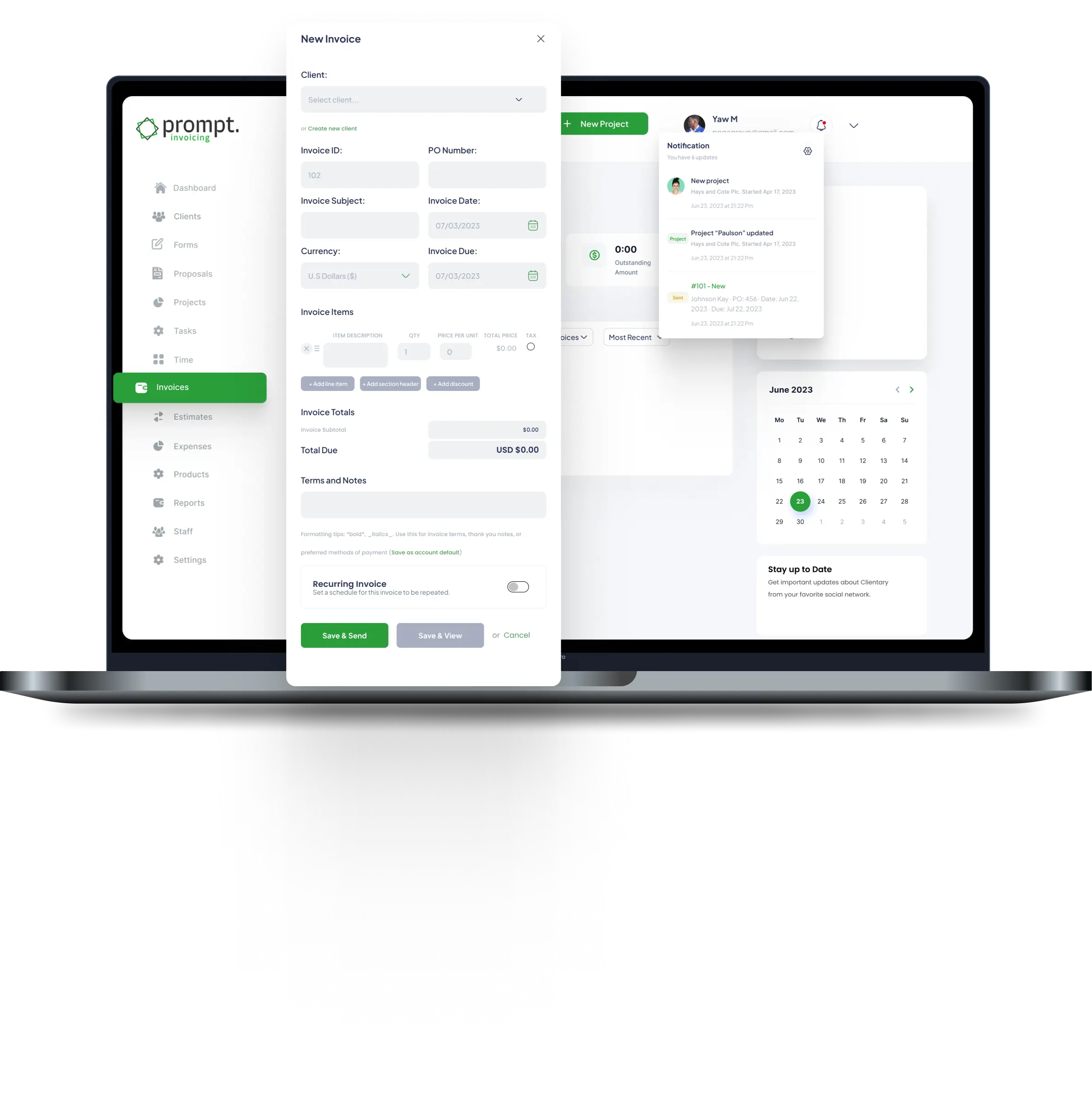
Make it a discipline to review your financials weekly or monthly so you are never caught off guard. Prompt Integrated’s invoicing feature gives you a real-time view of what has been billed, what has been paid, and what is still outstanding — so your revenue picture is always accurate and up to date.
Step 2: Cut unnecessary costs
Not every expense on your books is earning its place.
Take a deliberate look at what you are spending and ask the hard question: does this cost directly contribute to revenue or growth? If the answer is no, it is worth cutting or reducing. Common culprits include unused software subscriptions, overpriced suppliers, and operational habits that made sense at an earlier stage but no longer serve the business.
Small savings add up quickly. Trimming waste across several areas of the business can meaningfully improve your profit margins without requiring you to earn a single extra cedi or rand.
Prompt Integrated’s expenses management feature makes it easy to log, categorise, and review every business expense in one place — giving you the visibility to spot waste and act on it before it quietly erodes your margins.
Step 3: Focus on high-performing products or services
Not everything you offer delivers the same return.
Some products or services generate higher profits, sell faster, and bring customers back more reliably than others. Concentrating your energy on these high performers — rather than spreading your efforts thinly across everything — is one of the most efficient ways to drive meaningful growth.
Start by identifying your best-selling and most profitable offerings. Then promote them more actively, look for ways to improve their quality, and explore whether bundling them with complementary products could increase the average value of each sale.
Step 4: Price your products strategically
Pricing is one of the most consequential decisions a business owner makes, and it is also one of the most commonly mishandled.
When prices are set too low, you attract the wrong customers, compress your margins, and limit your capacity to reinvest in the business. Competing purely on price is a race that very few businesses win. Competing on value is a far more sustainable strategy.
Set your prices by factoring in the full cost of production, your operating expenses, and the profit margin you need to grow sustainably. Your pricing should support the business, not just cover the basics.
Step 5: Improve operational efficiency
Inefficiency is a quiet but persistent drain on profit.
Manual processes, disorganised workflows, poor inventory tracking, and avoidable errors all cost time — and time, in a growing business, is money. The good news is that most operational inefficiencies are fixable once you can see them clearly.
Automating repetitive tasks is one of the highest-return moves available to small businesses. From invoicing to payroll to expense tracking, automation reduces errors and frees your team to focus on work that actually moves the business forward.
Prompt Integrated is built specifically for this. Its suite of tools — covering invoicing, payroll, expenses, and project management — helps you run a tighter, more efficient operation without the admin overwhelm.
Step 6: Strengthen cash flow management
A business can be profitable on paper and still run into serious trouble if cash flow is poorly managed.
Late payments, inconsistent invoicing habits, and unclear payment terms are among the most common reasons growing businesses hit unnecessary turbulence. The fix is straightforward: send invoices promptly, set clear payment terms from the start of every engagement, and follow up consistently on anything that goes overdue.
Prompt Integrated’s invoicing feature streamlines the entire process — from creating and sending professional invoices to tracking payment status — so you always know exactly where your cash flow stands and can act quickly when something needs attention.
Step 7: Build strong customer relationships
Acquiring a new customer costs significantly more than retaining an existing one. That single fact makes customer retention one of the most important levers for long-term profitability.
Loyal customers buy more frequently, refer others to your business, and require far less convincing than someone encountering your brand for the first time. As retention improves, your marketing costs come down and your revenue becomes more predictable — both of which directly strengthen your bottom line.
Invest in excellent customer service, follow up meaningfully after sales, and build loyalty incentives that reward your best customers for staying. These are not soft, optional gestures — they are core commercial strategies.
Step 8: Use data to make better decisions
Guesswork is expensive. Data is not.
Businesses that consistently outperform their competitors are almost always better at tracking what is actually happening — sales trends, customer behaviour, product performance, and cost patterns — and using those insights to make informed adjustments.
Review your reports on a regular cadence. Look for what is working and scale it. Look for what is underperforming and either fix it or cut it. The businesses that grow most reliably are the ones that treat every data point as an opportunity to improve.
Prompt Integrated’s project management feature gives you a structured view of your team’s output and project progress, making it easier to identify bottlenecks, allocate resources effectively, and keep your operations aligned with your financial goals.
Step 9: Reinvest in your business
Growth requires fuel. That fuel is reinvestment.
Rather than drawing out all available profit, commit to allocating a consistent percentage back into the business — whether that goes toward marketing, better tools, staff training, or product development. This is not an optional extra for businesses that are doing well. It is a core discipline for any business that intends to keep growing.
Set a fixed reinvestment percentage that feels sustainable, and treat it with the same discipline you apply to any other business expense. Paying your team well and on time is also a critical part of that reinvestment. Prompt Integrated’s payroll feature ensures that salaries and contractor payments are processed accurately and on schedule — building the kind of internal trust that holds a growing team together.
Step 10: Think long-term
Short-term gains can be seductive. They can also be dangerous if they come at the expense of long-term stability.
The businesses that endure are those built on steady, consistent growth — not quick wins that burn out fast. That means planning ahead rather than just reacting, staying consistent in your operations even when things get difficult, and being willing to adapt your strategy as your market evolves.
Sustainable growth is not glamorous. It is the result of good habits, applied consistently over time.
Common mistakes to avoid
Many of the challenges businesses face are the result of avoidable patterns. Watch out for these:
- Failing to track finances regularly — you cannot make good decisions without accurate data
- Mixing personal and business money — this creates confusion, tax complications, and a distorted view of your actual profitability
- Ignoring cash flow — even profitable businesses can fail when cash flow is neglected
- Underpricing products or services — low prices feel like a competitive advantage until they quietly hollow out your margins
- Relying too heavily on manual processes — manual work takes time, introduces errors, and does not scale
Recognising these pitfalls early — and addressing them deliberately — positions your business for far greater stability.
Final thoughts
Boosting profits and building a sustainable business is not about working harder. It is about working with greater clarity and better tools.
When you understand your numbers, control your costs, concentrate on what is generating real returns, and put the right systems in place, you create a business that does not just survive — it compounds its own success over time.
Prompt Integrated is designed to support exactly that kind of business. From invoicing and payroll to expenses and project management, it brings everything you need to manage and grow your business into one platform — purpose-built for African SMEs and freelancers who are serious about building something that lasts. Get started with Prompt Integrated today.










Leave A Comment