

October 10, 2026
article by the prompt team

Most people want to be part of an organisation that is genuinely moving forward — making consistent progress toward a clear set of goals that matter to everyone involved. As a business owner in Ghana, that is almost certainly the kind of organisation you are trying to build.
But sustainable growth does not happen by default. It stagnates for recognisable reasons: the wrong skills in the team, customers who are not being served well enough, or a business strategy that is too vague to give anyone real direction. Understanding those obstacles — and addressing them deliberately — is what separates businesses that grow consistently from those that plateau despite genuine effort.
This article offers practical guidance on how to manage these challenges in a way that supports sustainable, long-term growth for your business and everyone in it.
Here’s what we’ll cover:
- Your employees make your business go around
- Your customers effectively own your business
- Design your business for scale
- Final thoughts
Your employees make your business go around
If your employees are motivated, engaged, and genuinely cared for, your customers will naturally be well looked after. The connection between a healthy internal culture and an excellent customer experience is direct and well-documented — and it is one of the most powerful levers available to any Ghanaian small business owner who wants to grow sustainably.
One of the most effective ways to create that motivated, engaged team is to embrace the individuality of each person you employ. Every member of your team is different — different strengths, different motivations, different ways of working at their best. Taking a genuine interest in who your people are, what matters to them, and what makes them perform well is not a management technique. It is the foundation of a workplace where people actually want to give their best.
Equally important is giving your team clarity about what you expect from them. Clear expectations achieve several things simultaneously: they promote accountability and make performance easier to assess fairly, they empower people to work independently without needing constant direction, and they eliminate the kind of redundant, overlapping work that wastes time and creates frustration.
Those expectations should connect visibly to the bigger goals of your business — so that every employee understands not just what they are doing, but why it matters. In Ghana’s relationship-driven business culture, this sense of purpose and shared direction is a powerful motivator.
Consider a practical example: if you run a financial advisory business in Accra and you are trying to deepen your relationships with clients, an efficient administrator who keeps your operations organised frees up your time to focus on exactly that. Acknowledging that contribution explicitly — telling your administrator how much their work matters to your ability to serve clients well — is a small investment of time that pays back significantly in engagement and loyalty.
Finally, pay attention to your management structure. Highly hierarchical organisations tend to slow down decision-making and suppress the kind of collaborative problem-solving that drives innovation. Flatter structures — where ideas can come from anywhere in the team and reach leadership without passing through multiple layers — tend to produce better thinking and faster adaptation to change.
Your customers effectively own your business
This might sound dramatic — but in Ghana’s increasingly connected, social-media-driven business environment, it is closer to the truth than most business owners are comfortable acknowledging.
The days when a poor customer experience was contained to losing a single client are long gone. An unhappy customer with a social media following — or simply a wide network of contacts across WhatsApp and Facebook — can damage a business’s reputation far faster than any advertising campaign can repair it. Conversely, a delighted customer who takes to Instagram or LinkedIn to recommend your business enthusiastically is one of the most powerful and cost-effective marketing forces available to you.
If sustainable growth is your goal, the surest path to it is consistently delivering an experience that makes customers want to tell other people about you. Not just satisfied customers — genuinely delighted ones who feel that your business went beyond what was expected and made a real difference.
To harness the full potential of those happy customers, you need to make it easy for them to talk about your business and engage with it publicly. This means building a community around your brand — creating the platforms and spaces where customers can share their experiences, ask questions, and feel connected to something beyond a transactional relationship.
In practice for a Ghanaian small business, this might mean choosing one or two social media platforms that your target customers actually use — Instagram for consumer-facing businesses, LinkedIn for B2B — and building a consistent, authentic presence there that reflects your values and personality. It might mean a monthly WhatsApp broadcast or email newsletter that your customers look forward to receiving. Or it might mean showing up at industry events, local markets, or community gatherings where face-to-face connection with your audience is possible.
The secondary benefits of building that community are equally valuable. It gives you a real-time window into how your customers feel about your business, how their needs are evolving, and what they wish you offered that you currently do not. That intelligence is what allows you to adapt ahead of the market rather than react to it after the fact.
Design your business for scale
If you have serious ambitions for your business in Ghana, you need to make sure the systems, structures, and habits you are building today can actually handle the growth you are planning for. Scaling a business that is built on manual processes, unclear responsibilities, and ad hoc systems is significantly harder — and more painful — than scaling one that was designed with growth in mind from the beginning.
There are three areas to focus on.
1. Let the main thing stay the main thing
Stephen Covey’s principle — “let the main thing stay the main thing” — is deceptively simple and relentlessly relevant. As a business grows, the opportunities multiply, the distractions multiply alongside them, and the temptation to pursue interesting tangents can quietly pull focus away from the core work that actually drives the business.
Before authorising significant spending, launching a new product or service, or expanding into a new area, check honestly whether that decision aligns with your core purpose. Staying focused on what your business does best is what improves your ability to identify real opportunities, deliver consistently for your customers, and maintain the clarity of direction that your team needs to perform well.
2. Do not be afraid to outsource
As your business grows, there will be tasks and challenges that your current team is not equipped to handle — and trying to handle them in-house anyway costs more than outsourcing to a specialist.
Whether it is web development, legal documentation, marketing strategy, or financial analysis, there are professionals in Ghana with deep expertise in each of these areas who can do the work better and faster than a generalist team stretched beyond its competence. Adopting a mindset where outsourcing is the obvious choice for specialist work — rather than the last resort — removes a significant amount of the friction that slows growing businesses down.
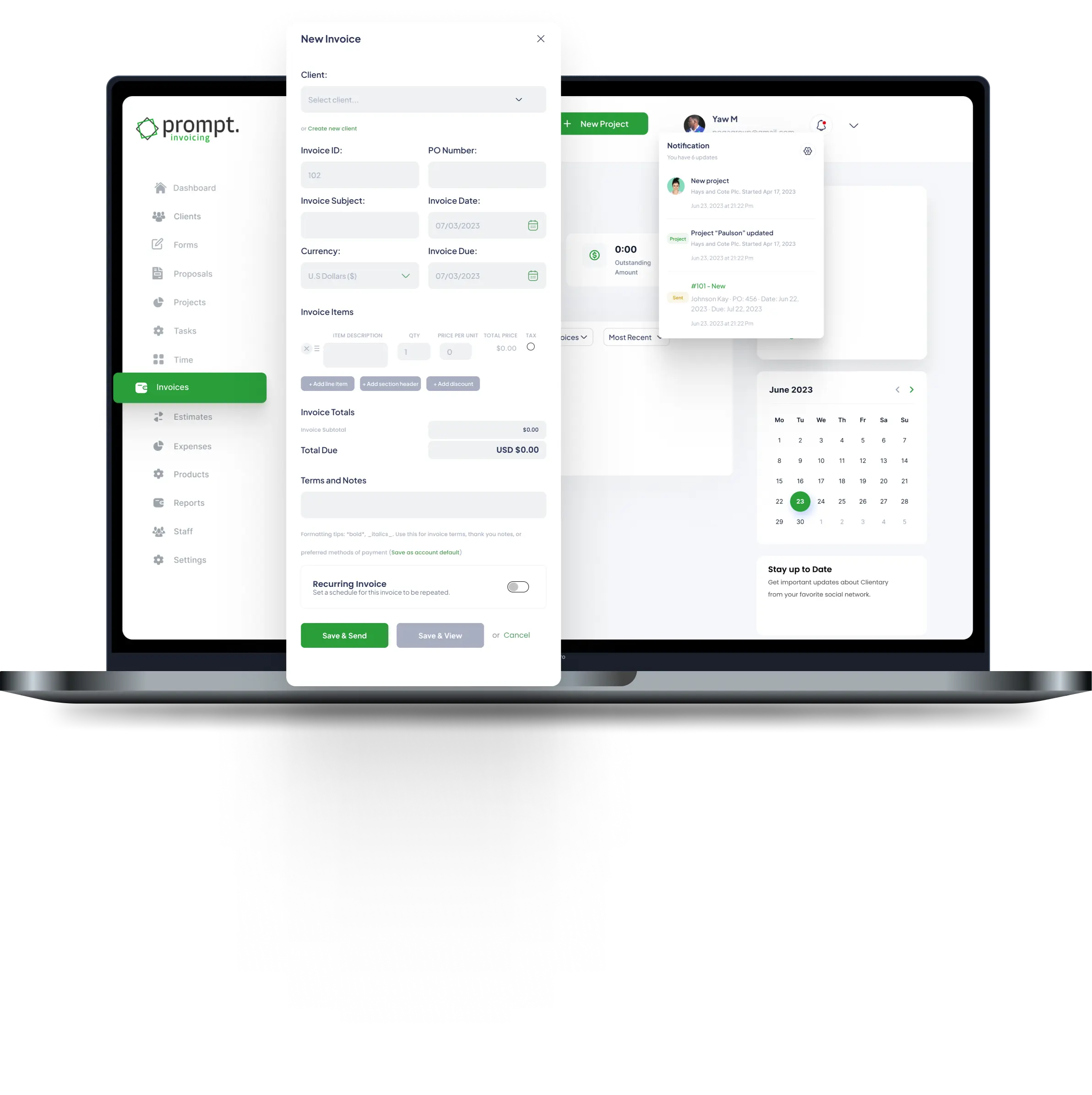
This thinking extends to the software your team uses. Cloud-based tools that handle invoicing, payroll, expense management, and project coordination are a form of outsourcing the administrative complexity of running a business to systems that do it reliably, automatically, and at a fraction of the cost of doing it manually.
Prompt Integrated is built precisely for this — giving Ghanaian businesses invoicing, payroll, expense management, and project management in one platform that handles the administrative work so your team can focus on the work that actually generates value. Embracing this kind of technology early also makes scaling significantly easier later — because the systems are already in place and your team is already comfortable using them.
3. Create genuine career progression opportunities
Losing a skilled, experienced employee is expensive in every sense. There is the direct cost of recruitment and onboarding. There is the loss of institutional knowledge — the understanding of your clients, your processes, and your business that only comes from time spent inside the organisation. And there is the impact on team morale when someone valued decides to leave.
Structuring your business in a way that gives employees a real path for growth — opportunities to develop new skills, take on greater responsibility, and progress toward their personal career goals — is one of the most effective retention strategies available.
In Ghana’s talent market, where skilled professionals have increasingly attractive options and career mobility is growing, offering that kind of development opportunity is not just good people management. It is a competitive advantage in attracting and keeping the people your business needs to grow.
Retained employees bring retained knowledge. They are less likely to repeat the mistakes that new hires make during their learning curve. They carry the relationships with clients and suppliers that took years to build. And they provide the continuity of leadership and institutional memory that sustainable growth requires.
Final thoughts
Sustainable growth in Ghana does not happen by accident. It is the result of deliberate choices — about how you look after your people, how you serve your customers, and how you design your business to handle the scale you are working toward.
Set aside time regularly to assess honestly how your business is doing in each of the areas covered in this article. Where are the gaps? Where are the opportunities? What needs to change — and what is already working that deserves more investment?
The businesses that grow most sustainably in Ghana are those that treat their people as their most important asset, their customers as the ultimate arbiters of their success, and their operational systems as the infrastructure that makes everything else possible.
Prompt Integrated is built to be part of that infrastructure — giving Ghanaian small and growing businesses the tools they need to manage their finances, their teams, and their operations professionally and efficiently as they scale. Get started with Prompt Integrated today.










Leave A Comment