

November 04, 2026
article by the prompt team
Many small businesses in Ghana hire people on a handshake or a WhatsApp message. It feels quick and friendly, and when everything goes well, nobody questions it. But when a dispute comes up over pay, leave, working hours, or termination, the business has nothing in writing to point to.
An employment contract fixes that. And with e-signatures, you can draft it, send it, get it signed, and store it in minutes, without printing, scanning, or chasing anyone.
Here’s what we’ll cover:
- Why every employee needs a written contract
- What happens without one
- A practical example: a catering business in Kumasi
- How e-signatures make contracts faster and easier
- What to include in an employment contract
- Is an e-signature legally valid in Ghana?
- Getting started
- Final thoughts
Why every employee needs a written contract
Under the Labour Act, 2003 (Act 651), employers in Ghana are expected to provide employees with written particulars of their employment, including pay, working hours, leave, and the terms of termination. A written contract does this and more.
For you, it sets clear expectations from day one. For your employee, it provides security and clarity about what they are agreeing to. For both of you, it removes guesswork. Nobody has to rely on memory when someone asks, “What did we agree on?”
What happens without one
Without a signed contract, small disputes become expensive ones. Common problems include:
- Disagreements over pay. The employee remembers one salary, the employer remembers another.
- Confusion over leave and notice periods. Neither side is sure how many days of leave were promised or how much notice is required.
- Weak position in a dispute. If a matter is escalated to the National Labour Commission, a business with no written terms struggles to show what was agreed.
- Unclear duties. Employees take on tasks outside their role, or refuse tasks they did not know were part of the job.
A contract does not prevent every disagreement, but it gives you a clear reference point when one arises.
A practical example: a catering business in Kumasi
Imagine a catering business in Kumasi that hires cooks, drivers, and serving staff, including extra people for busy event seasons.
Without a proper system, the owner agrees terms verbally. Months later, a driver says he was promised a transport allowance, and the owner remembers it differently. There is no record, the relationship sours, and the business loses a good employee.
With Prompt Integrated, the owner handles every hire the same way:
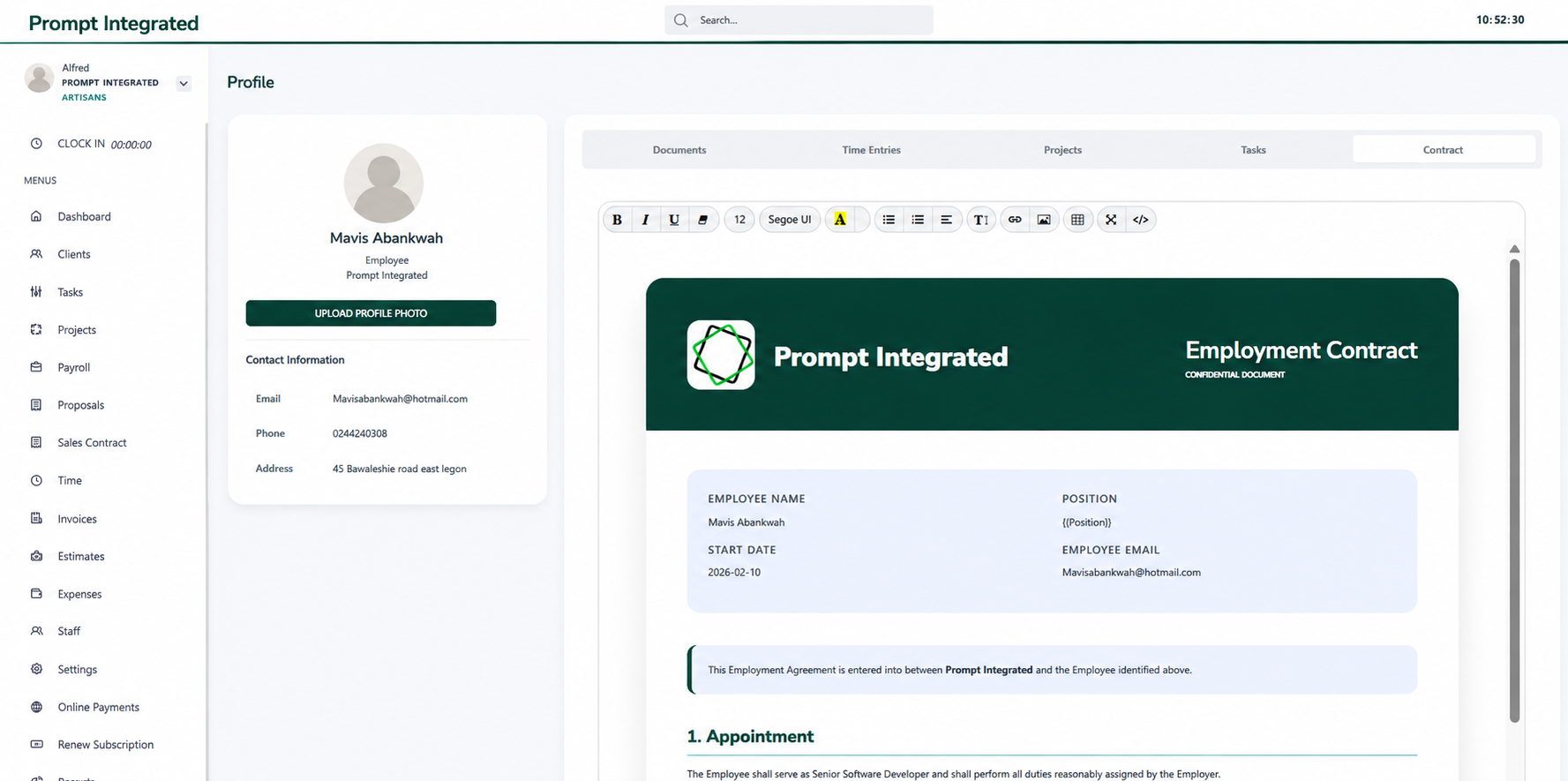
- Starts with a ready-made contract template and adjusts it for the role, salary, and start date.
- Sends the contract to the employee by email.
- The employee reviews it on their phone and signs electronically.
- The signed contract is saved automatically in the document manager, in the cloud.
- The owner can retrieve it in seconds if a question ever comes up.
For seasonal staff, the same process takes minutes. Every worker has a clear, signed agreement, and the owner has a complete record without a filing cabinet.
How e-signatures make contracts faster and easier
Traditional contracts mean printing, signing by hand, scanning, and sending back, often over WhatsApp. It is slow, and documents get lost or arrive unclear.
E-signatures remove those steps:
- Speed. A contract can be drafted, sent, and signed in a single day, sometimes within minutes.
- Sign from anywhere. Employees can sign on a phone, tablet, or laptop, wherever they are.
- Automatic storage. The signed document goes straight into your document manager, so nothing gets misplaced.
- A clear record. You can see when the contract was sent and when it was signed.
- Professional first impression. A smooth onboarding process shows new hires they are joining a well-run business.
Prompt Integrated’s document manager also lets you store CVs, personnel handbooks, and other HR documents in the same place as signed contracts.
What to include in an employment contract
Every contract should be clear and written in plain language. At a minimum, include:
- Employee and employer names and contact details
- Job title and a description of duties
- Start date, and the end date for fixed-term roles
- Salary, allowances, and payment frequency
- Working hours
- Annual leave, sick leave, and other leave entitlements
- SSNIT contributions and tax deductions
- Probation period, if any
- Notice period and termination terms
- Confidentiality and any other business-specific terms
Have a lawyer familiar with Ghana’s employment law review your template before you use it widely. Once you have a solid template, you can reuse it for every hire.
Is an e-signature legally valid in Ghana?
Yes. Ghana’s Electronic Transactions Act, 2008 (Act 772) recognises electronic signatures and electronic records, so a contract signed electronically can carry the same legal weight as one signed on paper in most circumstances. For anything unusual, check with your legal adviser.
Getting started
With Prompt Integrated, getting started is simple:
- Choose a contract template and customise it for the role.
- Send it to the employee by email.
- The employee signs electronically.
- The signed contract is stored automatically in the cloud.
Once the employee is on board, you can manage their payroll, including SSNIT and PAYE, from the same platform. Want to see it in action? Book a demo.
Final thoughts
A written employment contract protects your business, your employees, and the relationship between you. E-signatures make it faster and cheaper than ever to put those agreements in place, so there is little reason to rely on a handshake any longer.
Prompt Integrated brings contracts, payroll, invoicing, expense management, and project management together in one platform built for Ghanaian businesses. Get started with Prompt Integrated today.









Leave A Comment