

September 17, 2026
article by the prompt team

Most business owners want to feel in control of their finances. But what does that actually mean in practice — and how do you get there?
If you are running a small business in Ghana and you sometimes feel like you are reacting to your financial situation rather than directing it, you are not alone. Many Ghanaian entrepreneurs are deeply capable at what they do — whether that is manufacturing, trading, providing services, or building technology — but find the financial management side of the business harder to stay on top of.
Financial management is the tool that changes that. It is how you move from reacting to your numbers to understanding them, planning with them, and using them to make better decisions about where your business is going.
This guide explains what financial management actually involves, why it matters for small businesses in Ghana, and how putting the right practices in place can give you a genuinely stronger foundation for growth.
Here’s what we’ll cover:
- What financial management actually means
- The goal of financial management
- Financial control and monitoring
- Risk management
- Making better decisions
- Strategic planning and goal setting
- Using your resources as efficiently as possible
- Preparing your business for the future
- Final thoughts
What financial management actually means
Financial management is the collection of strategies, tools, and routines that help a business plan, monitor, and control its financial resources in a way that supports its goals.
In simpler terms: it is about using what you have as efficiently as possible so that your business can achieve what it is trying to achieve.
In practice, financial management includes activities like:
- Using accounting and financial software to track income and expenses accurately
- Analysing your costs to understand where money is going and identify savings
- Evaluating your financial performance regularly to understand whether the business is moving in the right direction
Each of these activities gives you a piece of information. When you bring them together, you get a complete and current picture of your business’s financial health — and that picture is what enables you to make confident decisions, plan for growth, and identify challenges before they become crises.
The goal of financial management
Financial management is not an end in itself. It is a path to something more important: a business that is financially healthy, strategically focused, and capable of sustainable growth.
With the right financial management practices in place, your business can:
- Identify potential risks early and put plans in place to address them
- Ensure your resources — money, time, people, and equipment — are being used as effectively as possible
- Set clearer goals and track progress toward them with real data
- Achieve the profitability that makes everything else possible
For a Ghanaian small business navigating real challenges — from cedi volatility and rising costs to late-paying clients and unpredictable demand — this kind of financial clarity is not a luxury. It is the foundation of resilience.
Financial control and monitoring
One of the most fundamental aspects of financial management is keeping a close, consistent eye on your numbers — not once a quarter, but regularly, as a disciplined habit.
By building and following a budget, you create a baseline against which to measure what actually happens. When actual results deviate from the budget — either positively or negatively — you can investigate why and respond accordingly.
Good financial control allows you to:
- Spot budget overruns before they become serious problems
- Respond quickly when revenue is falling short of expectations
- Identify spending that is running above plan and take corrective action
- Discover opportunities to save — a supplier offering better terms, a service you are paying for but not using, or an operational process that is more expensive than it needs to be
In Ghana’s business environment, where external conditions can change quickly and margins are often tight, this kind of regular financial monitoring is what gives business owners the early warning they need to adapt rather than react.
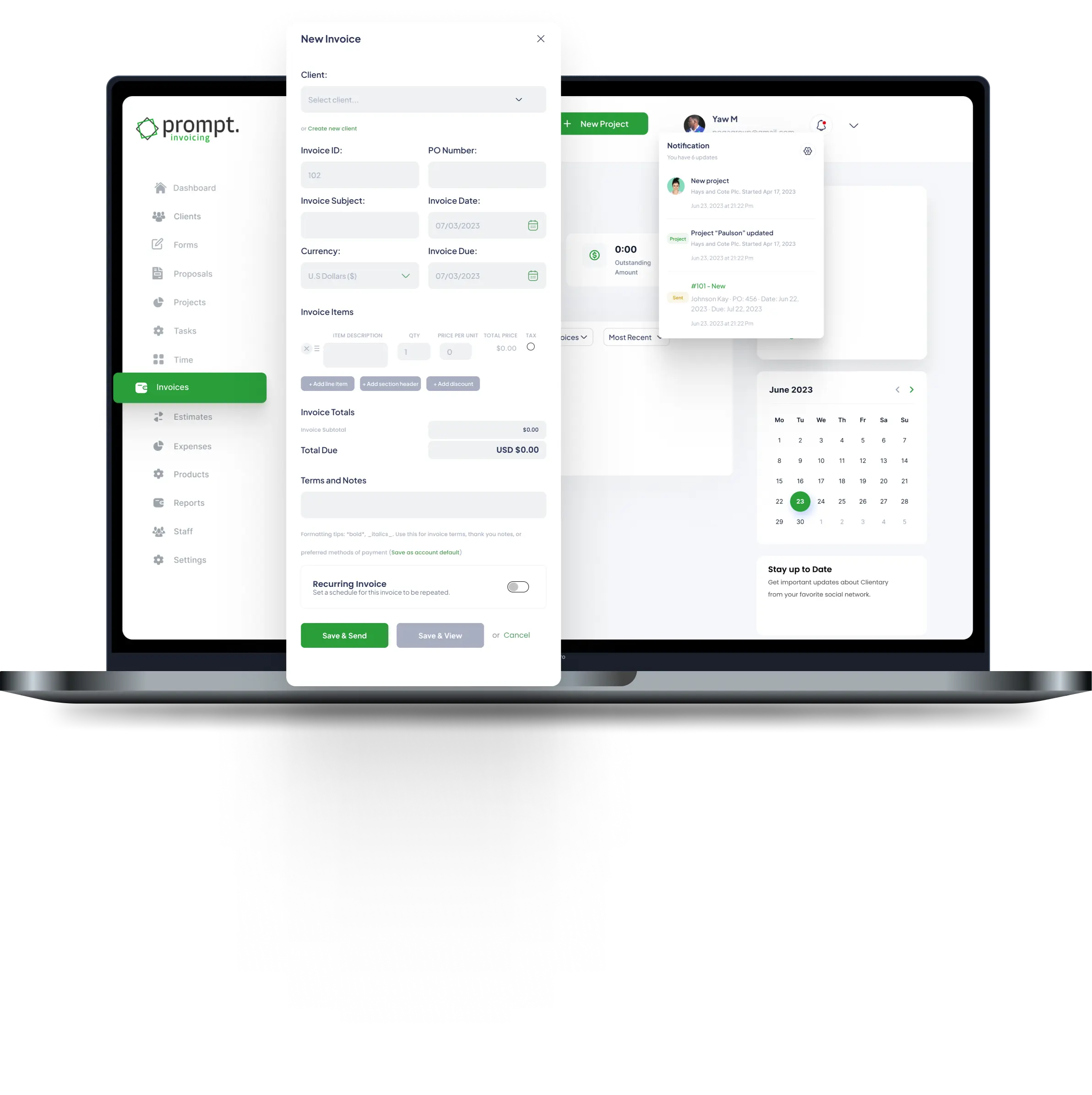
Prompt Integrated’s expense management and invoicing features give you a real-time view of your income and costs — so you always have an accurate, current picture of where your business stands financially, without waiting for a monthly report to find out.
Risk management
Every business faces financial risks. For Ghanaian small businesses, these risks are real and varied — currency depreciation affecting the cost of imported inputs, a key client reducing their business, an unexpected equipment failure, or a period of poor liquidity caused by late payments.
Financial management helps you identify these risks before they materialise and put measures in place to reduce their impact.
This is not about predicting the future with certainty — it is about understanding what could go wrong, how likely it is, and what the consequences would be. With that understanding, you can build the reserves, the contingency plans, and the operational flexibility that make your business more resilient.
Good risk management also means not being over-reliant on a single customer, a single supplier, or a single revenue stream — because when any of those relationships is disrupted, the impact is contained rather than catastrophic.
Making better decisions
Some business owners rely heavily on instinct — and good instinct built from experience is genuinely valuable. But instinct alone is not enough when the decisions involve significant financial commitments, new markets, or investments in people and equipment.
When you understand your financial position clearly — what you are earning, what you are spending, what your margins look like, and how different scenarios would affect your cash flow — you are far better equipped to evaluate options and choose the most profitable direction.
For example, should you hire a new team member right now? Should you take on a large order that will require significant upfront investment in materials? Should you invest in new equipment that will increase capacity but requires a loan? These are decisions that benefit enormously from financial analysis rather than guesswork.
There are established tools — like net present value and return on investment calculations — that can help evaluate specific investment decisions. But the starting point for all of them is having accurate, current financial data to work from.
Strategic planning and goal setting
Understanding your own business is important. But good financial management also requires an awareness of what is happening around you — in your market, in your industry, and in Ghana’s broader economic environment.
By tracking market trends and aligning your business strategy with the opportunities and challenges you can see developing, you position your business for growth rather than simply reacting to whatever arrives.
The goals you set should be realistic — grounded in an honest assessment of your resources, your capacity, and your starting point. They should be specific and measurable, so you can actually track progress. And they should be time-bound, so that accountability is built into the plan from the beginning.
Once goals are set, the discipline of tracking progress regularly — checking whether you are moving in the right direction and adjusting when you are not — is what turns planning from an annual exercise into a genuine operational habit.
Using your resources as efficiently as possible
Effective resource management is about making deliberate decisions about how your money, your time, your people, and your equipment are deployed — and continuously looking for ways to get more value from what you have.
This means identifying and reducing anything that creates unnecessary cost, slows down your operations, or prevents your business from performing at its best. It means investing in improvements that increase efficiency or reduce overhead over time. And it means ensuring that every part of your business is contributing to the overall goal rather than simply consuming resources without a proportionate return.
A practical example from Ghana’s context: a small food processing business might invest in more energy-efficient equipment that reduces electricity costs over time. A retail business might implement a basic inventory management system that prevents overstocking slow-moving items while ensuring popular products are always available.
These are both resource management decisions — and both are enabled by good financial data about what is actually costing money and where the returns are strongest.
Preparing your business for the future
Financial management is not just about solving today’s problems. It is a forward-looking discipline that prepares your business for what is coming — opportunities and challenges alike.
The businesses in Ghana that are best positioned for long-term growth are those that combine thorough financial monitoring with strategic planning and efficient resource use. They know their numbers. They set clear goals. They manage risk proactively. And they make decisions based on evidence rather than assumption.
Building these habits takes time — but the return on that investment compounds significantly. A business that has strong financial management practices in place is more fundable, more resilient, more attractive to talented employees, and more capable of seizing opportunities when they arise.
Final thoughts
Financial management does not need to be complicated. It starts with knowing your numbers — having an accurate, current picture of what is coming in, what is going out, and what the gap between them looks like. From that foundation, everything else — budgeting, goal setting, risk management, and strategic planning — becomes significantly more straightforward.
For Ghanaian small businesses that are serious about sustainable growth, building strong financial management habits is one of the highest-return investments available. And having the right tools in place to support those habits removes much of the friction that makes financial management feel difficult.










Leave A Comment