

March 26, 2026
article by the prompt team
Tax penalties are one of the most preventable costs a business can incur — yet they remain one of the most common financial setbacks facing small and medium-sized businesses in Ghana. A missed deadline here, an incorrectly filed return there, and what started as a manageable tax obligation can quickly snowball into fines, interest charges, and unwanted attention from the Ghana Revenue Authority (GRA).
The good news is that the vast majority of tax penalties are entirely avoidable. They rarely result from deliberate non-compliance — more often, they stem from poor record-keeping, misunderstood obligations, rushed filings, or simply losing track of deadlines during the busy cycle of running a business. With the right systems, habits, and tools in place, staying tax-compliant in Ghana is not only achievable — it becomes a routine part of how your business operates.
Prompt Integrated is a cloud-based business management platform built for Ghanaian businesses that brings invoicing, project management, expenses, payroll, and payments together in one place. Because accurate financial records are the foundation of sound tax compliance, Prompt Integrated gives business owners the real-time financial visibility they need to file correctly, pay on time, and avoid the penalties that hold too many Ghanaian businesses back. This guide covers the practical steps every Ghanaian business owner should take to stay on the right side of the GRA — illustrated with two real-world case examples.

Why Tax Penalties Happen in Ghana
Before you can avoid penalties, you need to understand what causes them. Most Ghanaian business owners face penalties for one of three reasons: missing filing deadlines, underpaying or delaying tax payments, or miscalculating tax obligations due to inaccurate records. Each of these leads to the same outcome — extra fees, accruing interest, and the stress of dealing with a regulatory authority that has become increasingly proactive in pursuing non-compliant taxpayers.
The GRA has modernised its systems significantly in recent years, including the launch of the GRA Taxpayer Portal for online filing and payment. This means that non-compliance is now easier to detect — and the window for businesses to fly under the radar without consequences has closed considerably.
1. Know Your Deadlines and File on Time
Filing late is one of the most common — and most avoidable — tax mistakes. Ghana’s tax calendar has fixed, non-negotiable deadlines that every business must adhere to. PAYE returns must be filed and remitted by the 15th of the following month. VAT returns follow the same monthly cycle. Annual income tax returns are due by 30 April of the following year.
The simplest step any business can take is to set calendar reminders well ahead of each deadline — not on the deadline itself, but at least two weeks before, giving enough time to gather records, check figures, and file without rushing. Even if you are unable to pay the full amount immediately, filing your return on time reduces the penalty exposure significantly. Late filing and late payment attract separate penalties under Ghana’s tax laws, and the combination can be costly.
2. Pay Your Taxes Promptly — and Partially If Necessary
Filing on time matters, but payment matters equally. If you delay payment, penalties and interest charges accrue from the due date — not from when the GRA contacts you. Many business owners make the mistake of waiting until they can pay the full amount before engaging with the GRA, by which point penalties have already compounded.
If you are facing a cash flow challenge that makes full payment difficult, the better approach is to pay what you can immediately — even a partial payment demonstrates good faith and reduces the amount on which penalties accumulate. Prompt Integrated’s expense and payroll modules help businesses budget for tax obligations throughout the year, so payment deadlines do not arrive as a surprise.
3. Keep Accurate and Up-to-Date Financial Records
Good records are the bedrock of correct tax filing. Without them, mistakes are not just likely — they are almost inevitable. Every income transaction, every business expense, and every receipt needs to be captured, categorised, and stored in a way that makes it retrievable when it is needed.
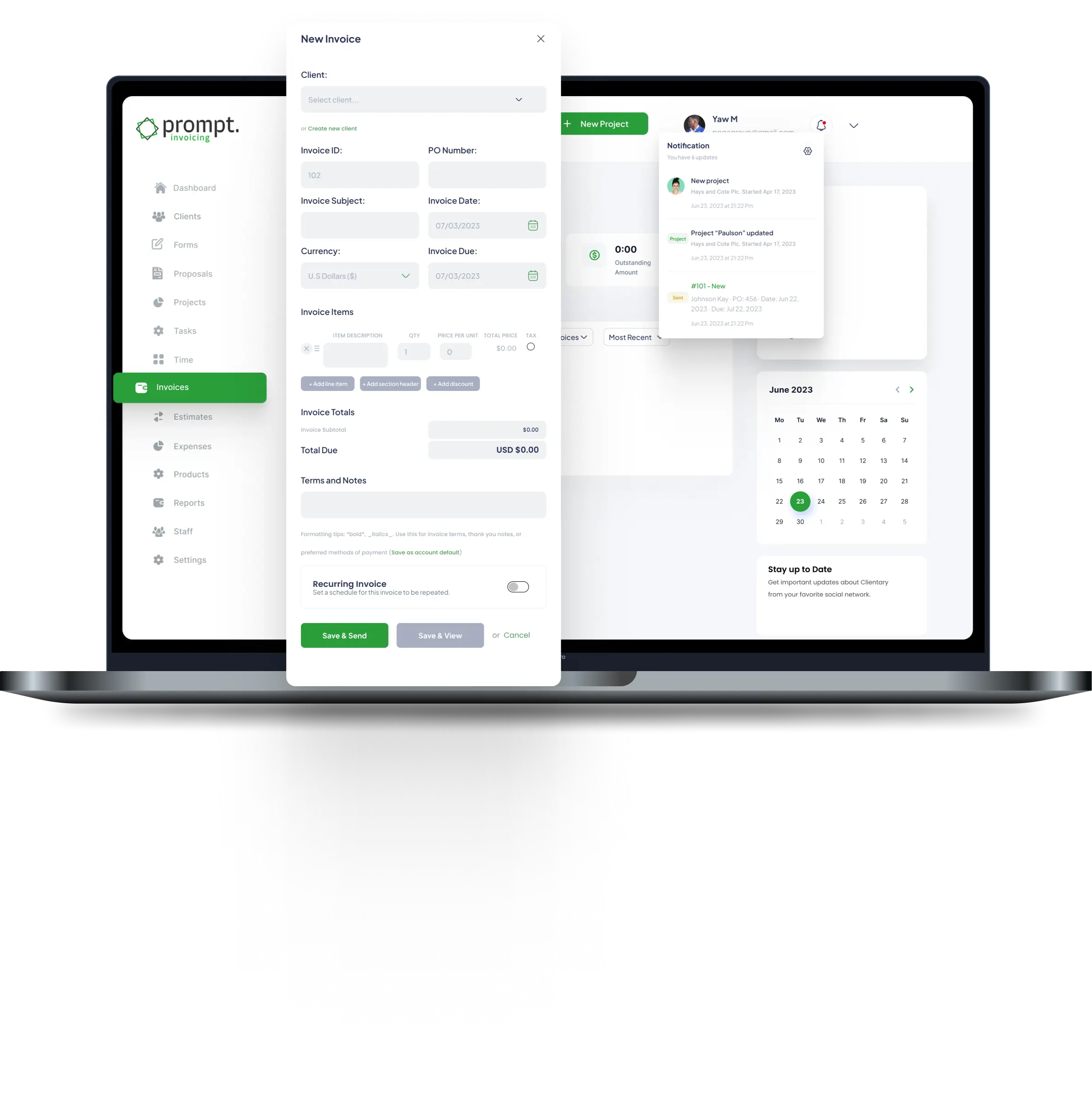
Prompt Integrated’s invoicing and expense management tools centralise all of this automatically. Every invoice raised, every expense recorded, and every payment received is logged in real time — building the complete financial record that accurate tax filing requires. Receipts can be attached digitally to expense entries, creating a paperless audit trail that is always organised and always accessible.
The GRA requires businesses to maintain records for a minimum of six years. Cloud-based storage through Prompt Integrated means those records are secure, backed up, and retrievable at any time.
4. Separate Business and Personal Finances
One of the most common — and most damaging — habits among Ghanaian small business owners is mixing personal and business finances. When income and expenses flow through the same account, tax reports become difficult to prepare accurately, legitimate business deductions are harder to identify, and the risk of errors on your return increases substantially.
The solution is straightforward: open a dedicated business bank account and ensure that all business transactions — income received, expenses paid, and payroll disbursed — flow through that account exclusively. Prompt Integrated’s financial management tools are designed to work with a dedicated business account, giving you a clean, accurate, and fully separated record of your business finances at all times.
5. Understand Exactly What You Owe
Many business owners in Ghana are penalised simply because they do not fully understand their tax obligations. PAYE, VAT, corporate income tax, SSNIT contributions, and Tier 2 pension payments each come with their own registration requirements, calculation methods, and filing frequencies — and the rules for each can change year on year as the GRA updates its guidance.
Key questions every Ghanaian business owner should be able to answer with confidence include: Is your business registered for VAT? If your annual turnover exceeds the GRA’s VAT registration threshold, registration is mandatory. Are you filing PAYE correctly for all employees — not just some? Are your SSNIT contributions being calculated on basic salary, not total income? Understanding these distinctions is the difference between compliance and a penalty notice.
6. Use Real Financial Data — Not Estimates
Guessing figures on a tax return — even with the best intentions — creates serious risk. Underestimates lead to underpayment and penalties. Overestimates lead to unnecessary tax bills. Both represent avoidable costs.
The only way to file accurately is to file from real, verified financial data. Prompt Integrated’s reporting tools give business owners access to accurate income and expense summaries at any point in the year — not just at year end. This means that when filing season arrives, the numbers are already there, verified, and ready to submit.
7. Review Your Finances Monthly — Not Just at Tax Time
One of the most costly habits in business is leaving financial housekeeping until tax season. When a full year of transactions is reviewed in a rush during April, errors and omissions are almost guaranteed. The businesses that stay consistently compliant are the ones that treat their finances as a monthly discipline rather than an annual task.
Setting aside time at the end of each month to review income, reconcile expenses, check payroll records, and confirm that tax payments are up to date takes far less time than trying to reconstruct a year’s worth of records in a hurry. Prompt Integrated’s dashboard makes this monthly review straightforward — all the relevant data is in one place, updated in real time, and organised by category.
8. Use Digital Tools to Eliminate Manual Errors
Manual bookkeeping processes are a significant source of tax errors. Transposed figures, missing entries, and miscalculated totals are common when records are maintained by hand or in disconnected spreadsheets. Digital platforms eliminate most of these risks by automating calculations, flagging inconsistencies, and generating accurate reports from verified data.
Prompt Integrated tracks income and expenses in real time, stores all records securely in the cloud, and generates financial reports that can be used directly for tax filing preparation — removing the manual effort and the human error that comes with it.
9. Work with a Professional When Your Business Grows
As a business grows in complexity — taking on more employees, multiple revenue streams, VAT obligations, and project-based billing — the value of working with a qualified accountant or tax adviser increases considerably. A professional can identify deductions you may be missing, ensure compliance with the most current GRA guidance, and represent your business if a query or audit arises.
The Institute of Chartered Accountants Ghana (ICAG) is the authoritative body for qualified accountants in Ghana and maintains a directory of accredited professionals. For businesses that are not yet ready for a full-time accountant, a quarterly review with a qualified adviser — using the clean, organised records that Prompt Integrated maintains — is a cost-effective way to stay protected.
Two Real-World Case Examples
Case Example 1: Kofi’s Electrical Contracting Business, Accra
Kofi runs a small electrical contracting firm in Accra with four employees. For the first three years of operation, he managed his finances in a notebook and a basic spreadsheet. Every year, preparing his PAYE returns and annual income tax submission involved reconstructing months of transactions from memory and bank statements — a process that took days, produced errors, and twice resulted in late filing penalties from the GRA.
After switching to Prompt Integrated, Kofi began recording every expense — materials, transport, subcontractor fees — directly in the platform at the point of incurrence, attaching digital receipts as he went. His payroll was processed through the platform each month, with PAYE and SSNIT calculated automatically. By the time his annual return was due, his records were complete, accurate, and ready to submit. In the first full year on the platform, he filed on time, paid on time, and incurred zero penalties — saving an estimated GHS 3,200 in fines and interest compared to the previous year.
Case Example 2: Abena’s Catering and Events Business, Kumasi
Abena operates a catering and events business in Kumasi that grew rapidly after winning a contract with a corporate client. The growth was welcome — but it pushed her annual turnover above the GRA’s VAT registration threshold, an obligation she was unaware of until she received a compliance notice eighteen months later. By that point, she owed backdated VAT, late registration penalties, and interest on unpaid amounts — a bill that significantly dented the profitability of what had been a strong year.
After settling her arrears and registering for VAT, Abena adopted Prompt Integrated to manage her invoicing and expenses. The platform’s real-time revenue tracking meant she could monitor her turnover against key thresholds throughout the year — giving her the visibility to act on compliance obligations proactively rather than reactively. Her subsequent VAT filings have been submitted on time each month via the GRA Taxpayer Portal, and she has not incurred a single penalty since.
Conclusion
Avoiding tax penalties in Ghana does not require a team of accountants or an encyclopaedic knowledge of tax law. It requires consistency, accurate record-keeping, an understanding of your obligations, and the right tools to stay organised throughout the year.
The businesses that stay compliant are not necessarily the largest or most sophisticated — they are the ones that treat their financial records as a daily discipline rather than a year-end scramble. They know their deadlines, file on time, pay what they owe, and use platforms like Prompt Integrated to ensure that the data they need is always accurate, always organised, and always ready.
Tax season should not be a source of stress for your business. With Prompt Integrated managing your invoices, expenses, payroll, and payments in one cloud-based platform, it does not have to be.
Take control of your business finances and stay ahead of the GRA. Get started with Prompt Integrated today and make tax compliance a seamless part of how your business operates.
Disclaimer: This article is for informational purposes only and does not constitute tax or legal advice. Always consult a qualified tax professional or refer to the Ghana Revenue Authority for guidance specific to your business circumstances.










Leave A Comment