

March 11, 2026
article by the prompt team
For any business operating in Ghana, understanding payroll tax is not optional — it is a legal obligation that directly affects your employees, your cash flow, and your standing with the country’s regulatory authorities. Yet for many entrepreneurs and growing businesses, the details of Ghana’s payroll tax system remain unclear, leading to costly errors, missed deadlines, and avoidable penalties.
Ghana’s payroll system stands out in the West African region due to its multi-tier structure. Employers must manage not only PAYE (Pay As You Earn) income tax deductions but also two distinct layers of social security contributions — Tier 1 and Tier 2 — in addition to the option of voluntary Tier 3 pension contributions. Combined with PAYE rates that climb to 35% for higher earners, the total cost of employment in Ghana adds up quickly and requires careful planning.
Prompt Integrated is a cloud-based business management platform built for Ghanaian businesses that automates payroll calculations, tracks employee deductions, and helps businesses stay on top of their PAYE and SSNIT obligations — all from one centralised platform. This guide walks you through everything you need to know about Ghana’s payroll tax system, from what it covers to how to file correctly and avoid the most common mistakes.
What Is Payroll Tax in Ghana?
Payroll tax in Ghana covers the taxes and social security contributions that employers are legally required to calculate, deduct, and remit on behalf of their employees each month. The main components are as follows.
PAYE (Pay As You Earn) is personal income tax deducted from employee salaries at graduated rates set by the Ghana Revenue Authority (GRA), with a top rate of 35% for resident employees. Non-resident employees working in Ghana are taxed at a flat rate of 25% on their Ghana-sourced employment income.
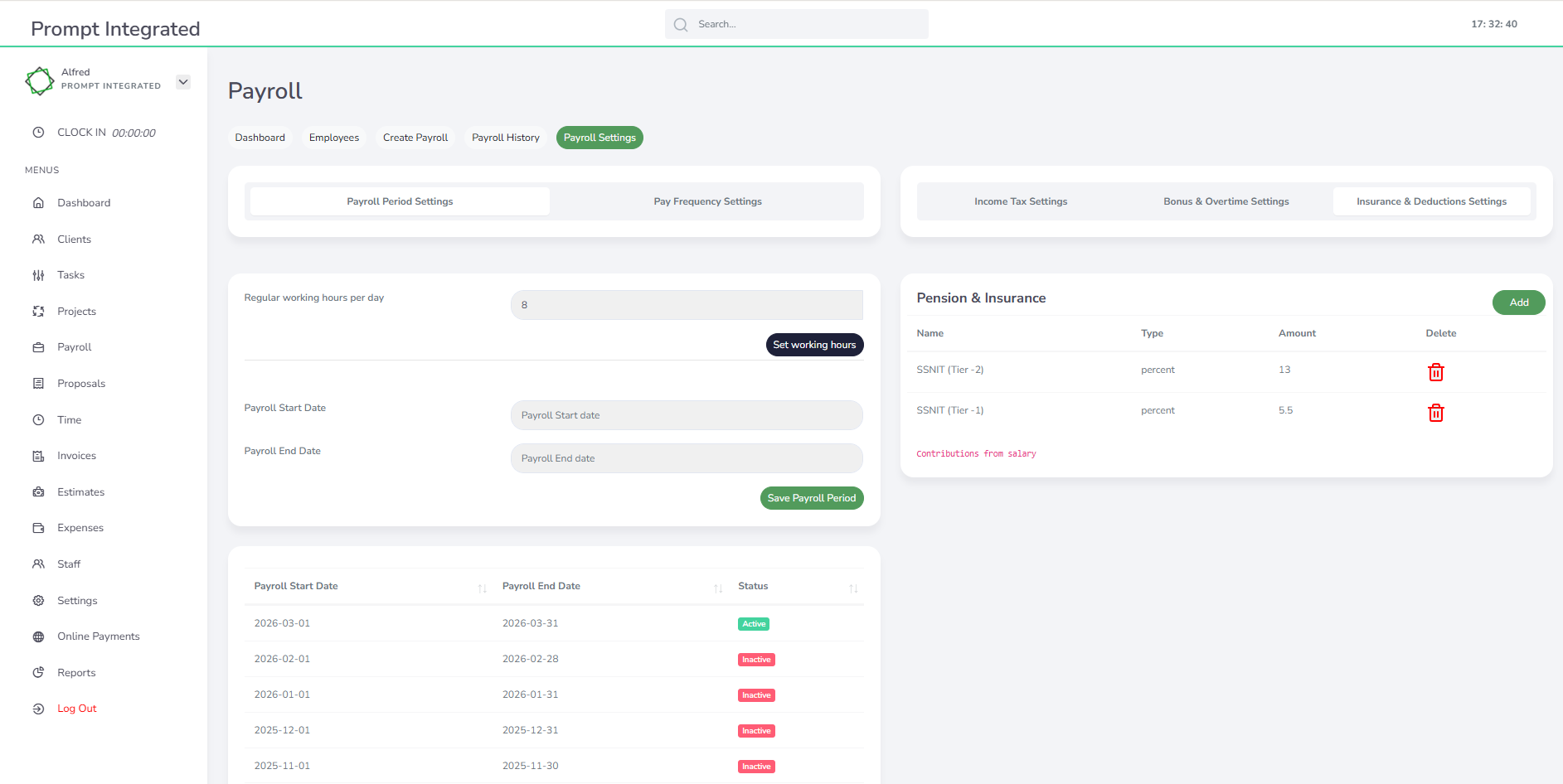
SSNIT Tier 1 is the mandatory social security contribution managed by the Social Security and National Insurance Trust (SSNIT). The total Tier 1 contribution is 13% of an employee’s basic salary — paid entirely by the employer, who then recovers 5.5% from the employee’s salary, with the remaining 7.5% borne by the employer.
SSNIT Tier 2 is an additional 5% of basic salary paid entirely by the employer to a licensed private pension trustee. This occupational pension contribution is separate from SSNIT and is managed by private fund managers regulated by the National Pensions Regulatory Authority (NPRA).
Tier 3 is a voluntary provident fund or personal pension scheme that employees or employers may contribute to for additional retirement savings. While not mandatory, it offers tax advantages that can be beneficial for both parties.
Who Does Payroll Tax Apply To?
Ghana’s payroll tax obligations apply to all employers operating in the country — both private and public sector — who have employees on their payroll. Specifically, this covers all employers with registered businesses in Ghana, all employees earning above the tax-free threshold, and non-resident employees working in Ghana who are taxed at the flat 25% rate.
Prompt Integrated’s payroll module is designed to handle the full range of employee types, ensuring that deductions are calculated correctly whether you are managing resident employees, non-residents, or a combination of both.
Why Getting Payroll Tax Right Matters
The consequences of payroll tax errors in Ghana extend beyond financial penalties. Mismanagement of PAYE and SSNIT obligations can trigger GRA audits, result in backdated tax liabilities covering multiple years, damage your business’s credit standing, and in serious cases, lead to enforcement action that disrupts operations entirely.
Beyond compliance, accurate payroll tax management helps you plan your cash flow more effectively. Knowing your exact monthly payroll tax obligations — including employer SSNIT contributions and PAYE remittances — allows you to budget with precision and avoid the cash flow surprises that catch many growing businesses off guard.
How the Payroll Tax Process Works
The payroll tax process in Ghana follows a clear sequence of steps that employers must complete each month. It begins with registering as an employer with both the GRA and SSNIT, and obtaining Tax Identification Numbers (TINs) for all employees. From there, PAYE is calculated each month using the GRA’s graduated tax rates, applied to each employee’s total taxable income.
SSNIT Tier 1 contributions are calculated on each employee’s basic salary — the employee’s 5.5% share is deducted from their pay, while the employer contributes the full 13% to SSNIT. The additional Tier 2 contribution of 5% is remitted separately to the employee’s chosen private pension trustee.
PAYE must be remitted to the GRA by the 15th of the following month via the GRA Taxpayer Portal. SSNIT contributions must be remitted by the 14th of the following month, either through the SSNIT Employer Self-Service Portal or by contacting your assigned SSNIT branch. Finally, employers are required to file an Annual Return of Employees by 30 April of the following year, summarising all employees’ earnings and tax deductions for the year.
Prompt Integrated automates each of these calculations and maintains the records needed for monthly filings and annual returns — dramatically reducing the time and risk involved in payroll processing.
What Forms Are Involved?
Ghana’s payroll tax system requires employers to maintain and submit several key documents. The Monthly PAYE Return is filed with the GRA and shows each employee’s earnings and tax deducted for the month. The SSNIT Contribution Report is submitted monthly to SSNIT, detailing contributions for each employee. The Annual Return of Employees, due by 30 April, lists all employees’ annual earnings and total tax deducted for the year. New employees must also be registered using the Employee Registration Form with both SSNIT and the GRA.
Keeping these records organised and accurate throughout the year — rather than scrambling at year end — is one of the most important habits a Ghanaian business can develop. Prompt Integrated’s expense and payroll tools maintain a live, organised record of all payroll transactions, making form preparation significantly more straightforward.
Key Information You Need Before Processing Payroll
Before processing payroll each month, employers should ensure they have the following information in place: Tax Identification Numbers (TINs) for all employees, SSNIT numbers for all employees, details of each employee’s basic salary and allowances, records of any non-cash benefits provided such as housing, vehicles, or meals, previous PAYE and SSNIT payment receipts, and the current year’s GRA tax tables, which are updated periodically and must reflect the most recent rates.
Non-cash benefits are a frequently overlooked area. Housing, company cars, and meal allowances provided to employees are considered taxable benefits and must be included in PAYE calculations. Failing to account for these is one of the most common triggers for GRA audit queries.
A Practical Example
To make this concrete, consider an employee who earns a basic salary of GHS 8,000 per month with a total monthly income of GHS 10,000 when allowances are included.
For SSNIT — calculated on the basic salary of GHS 8,000 — the employee’s Tier 1 contribution is GHS 440 (5.5%), the employer’s Tier 1 contribution is GHS 1,040 (13%), and the employer’s Tier 2 contribution is GHS 400 (5%).
For PAYE — calculated on total income minus the employee’s SSNIT contribution — the taxable income is GHS 9,560 (GHS 10,000 minus GHS 440). Applying the GRA’s graduated rates, the approximate monthly PAYE is GHS 1,800.
In total, GHS 2,240 is deducted from the employee’s pay (GHS 440 SSNIT plus GHS 1,800 PAYE), while the employer bears an additional GHS 1,440 above the salary cost (GHS 1,040 Tier 1 plus GHS 400 Tier 2).
Common Mistakes to Avoid
Several recurring errors trip up Ghanaian businesses when it comes to payroll tax compliance. Using outdated PAYE tax brackets is a frequent issue — the GRA updates its rates periodically and applying the wrong figures leads to under- or over-deduction. Confusing basic salary with total salary is another common mistake: SSNIT is calculated on basic salary only, while PAYE applies to total income including allowances.
Missing the SSNIT contribution deadline attracts a 3% monthly penalty on outstanding contributions — a charge that compounds quickly. Failing to register new employees with SSNIT within the required timeframe is also a liability. And as noted above, not accounting for non-cash benefits such as housing, cars, and meals in PAYE calculations is a common oversight that can result in significant backdated assessments.
Finally, applying the 25% flat rate to resident employees is a clear error — this rate applies only to non-residents working in Ghana.
Key Payroll Tax Deadlines at a Glance
Ghana’s payroll tax deadlines are fixed and non-negotiable. Monthly PAYE returns must be filed and payment remitted to the GRA by the 15th of the following month. SSNIT contributions must be remitted by the 14th of the following month. The Annual Return of Employees is due by 30 April of the following year.
Prompt Integrated helps businesses stay ahead of these deadlines by maintaining accurate, real-time payroll records that are always ready for submission — removing the last-minute scramble that leads to late filings and penalties.
Frequently Asked Questions
What are the PAYE tax brackets in Ghana? PAYE rates are graduated from 0% to 35%. The first GHS 490 of monthly income is tax-free. Rates then increase progressively through 5%, 10%, 17.5%, 25%, and 30%, reaching the top rate of 35% for higher earners. The full table is available on the GRA website.
Is SSNIT mandatory for all employees? Yes. All employees working under a contract of employment in Ghana must be registered with SSNIT. Contributions are mandatory for both employers and employees.
Is there a cap on SSNIT contributions? Yes. Contributions are capped at a basic salary of GHS 61,000 per month for the 2025–26 financial year.
What happens if SSNIT is paid late? A penalty of 3% per month is charged on outstanding SSNIT contributions, with no ceiling on how long this can accrue.
Do non-residents pay PAYE? Yes, but at a flat rate of 25% on their Ghana-sourced employment income, rather than the graduated rates that apply to resident employees.
Conclusion:
Ghana’s payroll tax system requires consistent monthly attention — from accurate PAYE calculations and timely GRA filings to SSNIT contributions and annual returns. The businesses that manage this well are those that treat payroll compliance not as a burden but as a core operational discipline.
Prompt Integrated makes this discipline accessible for every Ghanaian business, regardless of size. By automating payroll calculations, maintaining accurate employee records, and centralising your invoices, expenses, and payments alongside payroll in one cloud-based platform, it removes the complexity and risk from one of the most important financial obligations your business has.
Getting payroll tax right in Ghana is not just about avoiding penalties — it is about building the kind of financially disciplined, transparent business that earns the trust of employees, regulators, and future investors alike.
Ready to take the complexity out of payroll in Ghana? Get started with Prompt Integrated today and process your first payroll with confidence.









Leave A Comment