

February 15, 2026
article by the prompt integrated team
Payroll encompasses the processes through which employers calculate and distribute employee salaries, taxes, and necessary deductions, playing a crucial role in the efficient operation of any organization. In Ghana, payroll systems exhibit a broad spectrum of technological integration, ranging from fully automated software solutions to manual spreadsheets, reflecting the diversity present in both public and private sectors. This article will explore:
- Government payroll systems
- Private sector payroll
- The significance of payroll adoption
- Final thoughts
Government Payroll Systems
In government institutions, Ghana utilizes a centralized payroll system known as the Integrated Personnel and Payroll Database (IPPD), overseen by the Controller and Accountant-General’s Department. This system is intended to manage salaries, promotions, allowances, deductions, and adjustments for civil servants nationwide.
However, this system has faced challenges regarding data integrity and control. Historical issues with database accuracy and a lack of effective reconciliation tools have hindered the maintenance of accurate and error-free records.
In 2025, a major issue was uncovered by the Ghanaian government: over 81,000 suspected “ghost names” — fraudulent entries in the National Service Authority’s payroll — leading to a nationwide review and investigation mandated by the presidency.
Ongoing Efforts for Improvement
At the same time, efforts to enhance payroll integrity are in progress. For instance, in 2024, the government integrated the Akenten Appiah-Menka University of Skills Training and Entrepreneurial Development (AAMUSTED) into the national payroll platform, streamlining the inclusion of more university staff into the centralized payroll system and improving verification through national ID integration.
Private Sector Payroll: Increasing
Automation and Adoption
Traditional Practices vs. Modern Systems
Many small and medium enterprises (SMEs) in Ghana still rely on manual payroll processing, often utilizing Excel spreadsheets or basic internal systems managed by HR or finance personnel. Discussions among local professionals indicate that this reliance on manual tools stems from the perception that payroll software is an unnecessary expense. To address this, Prompt Integrated has developed a user-friendly and affordable payroll solution to support the government’s digitalization initiatives while streamlining the operations of small to medium-sized enterprises. Our cloud-based payroll platform is tailored to Ghana’s regulatory environment to enhance accuracy, compliance, and efficiency. Key features include:
- Salary calculations
- Payslip generation (email/SMS)
- Statutory deductions (PAYE, SSNIT, pensions)
- Leave and attendance tracking
- Employee self-service portals
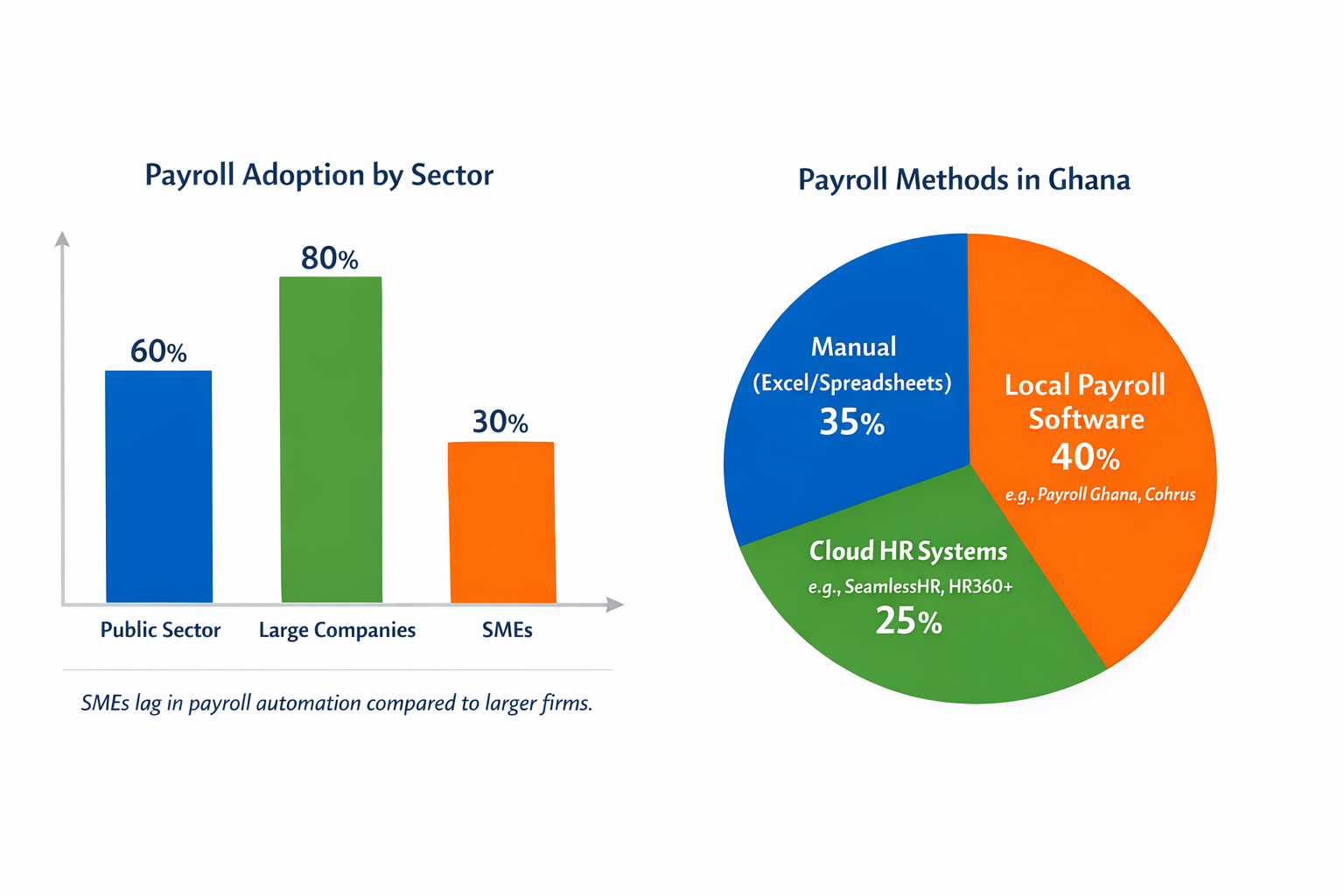
While adoption shows promise and is gaining traction, the current penetration rate of payroll software among small to medium-sized businesses remains relatively low, at around 30%. In comparison, adoption rates in the public sector and large private companies stand at approximately 60% and 80%, respectively, see table above;
Growth of Cloud and Automated Payroll Tools
Numerous local and international payroll platforms are being adopted by Ghanaian companies to enhance accuracy, compliance, and efficiency. However, many processes are still burdened by regulatory inefficiencies, such as missing API integrations, particularly at the Ghana Revenue Authority and SSNIT, making tasks like remittance of income tax (PAYE) and SSNIT contributions cumbersome and manual. Nevertheless, the increased penetration of payment systems like MoMo has facilitated seamless direct payments, ensuring that workers receive their paychecks on time. For example, Prompt Integrated collaborates with Payswitch Ghana to simplify direct payments for numerous Ghanaian companies and their employees.
Why Payroll Adoption Matters
Improved Compliance
Automated payroll systems like Prompt Integrated accurately and timely calculate statutory deductions such as PAYE (income tax) and SSNIT pensions/social security contributions, reducing the risk of fines and compliance errors. However, direct transfers to these respective authorities via direct API integrations are only possible through a partially automated system.
Efficiency and Accuracy
Modern payroll tools, like ours, process pay runs more rapidly and with fewer errors than Excel. This efficiency is particularly beneficial for companies with hundreds of employees or multiple payment schedules.
Employee Transparency
Cloud payroll systems allow employees to access their payslips, benefits, leave balances, and tax documents online, marking a significant advancement in modern HR operations. However, many still cling to manual payroll due to perceived costs and complexities, with software adoption often occurring gradually and influenced by recommendations from accountants or partners. Corporations and multinational employers tend to favor cloud payroll tools or integrated HR suites (such as SeamlessHR and HR360+) to navigate regulatory complexities, support remote workforces, and ensure reliable reporting across departments.
Challenges to Payroll Penetration
Despite the positive momentum, cost barriers hinder some SMEs from adopting payroll software. To address this, Prompt Integrated offers a mixed pricing model at an affordable rate, providing companies with a reasonable entry point into digitizing their payroll. Additionally, the often-overlooked skills gap in HR and finance teams can impede the adoption of advanced systems. While legacy systems in public institutions are undergoing reform, they have not yet achieved full modernization.
Final Thoughts: The Future of Payroll in Ghana
Payroll adoption in Ghana is on a positive trajectory, transitioning from centralized government systems to dynamic cloud platforms that serve private businesses of all sizes.
While traditional manual processes remain entrenched in smaller firms, organizations that embrace automated payroll systems unlock improved compliance, transparency, and operational efficiency.
As technology evolves and awareness grows, payroll penetration in Ghana is poised for further expansion—benefiting both employers and employees through accurate, timely, and compliant payroll practices.








Leave A Comment