

March 13, 2026
article by the prompt team
There is a financial revolution happening across Africa — and it is moving faster than most people realise.
From the streets of Accra to the markets of Lagos, from the farms of rural Kenya to the offices of Cape Town, digital financial technology is reshaping how Africans save, spend, borrow, invest, and get paid. This is not a future promise. It is a present reality — and for businesses and investors who recognise it early, the opportunities are extraordinary.
The African fintech revolution is not just about convenience. It is about access. It is about the trader in Kumasi who can now receive payment from a client in Accra without setting foot in a bank. It is about the construction firm in Takoradi that can pay its workers digitally on payday without issuing physical cash. It is about the freelance consultant in East Legon who sends a professional invoice and gets paid the same day through an integrated payment gateway. This is the world that fintech is building in Africa — and Prompt Integrated is proud to be part of building it in Ghana.

Africa Is the World’s Most Exciting Fintech Frontier
The investment community is waking up to what those on the ground in Africa have long known. Between 2015 and 2022, the number of African tech companies receiving funding grew sevenfold to more than 700 per year — one of the fastest rates of tech sector expansion ever recorded. Fintech has been the engine of this growth, attracting the largest share of investment and producing eight of Africa’s nine unicorns.
But the most compelling argument for African fintech is not the historical growth curve — it is the structural opportunity that still lies ahead. The African Development Bank puts the continent’s annual infrastructure funding gap at between $50 and $90 billion. The International Finance Corporation (IFC) estimates a $330 billion financing gap for SMEs across Sub-Saharan Africa alone. These are not just problems — they are markets waiting to be served. And fintech is uniquely positioned to serve them at scale, at speed, and at a fraction of the cost of traditional financial infrastructure.
The Multiplier Effect: Why Fintech Investment in Africa Pays Dividends Beyond Finance
What makes African fintech truly exceptional as an investment thesis is its multiplier effect. Unlike fintech in more mature markets — where innovation tends to improve efficiency within an already functional system — African fintech frequently creates the system itself. It does not just make things faster. It makes things possible.
Consider healthcare. Private providers deliver close to half of all healthcare in sub-Saharan Africa, including critical services such as malaria diagnosis, vaccinations, and maternal care. Yet many of these providers are small businesses that struggle to access working capital. Fintech solutions that offer mobile-based lending, insurance distribution, and digital payments are directly enabling more healthcare capacity to exist — and the World Health Organisation has documented extensively how financial barriers are one of the primary drivers of poor health outcomes across the continent.
In education, platforms like SchoolPay are using fintech to solve the fee collection inefficiencies that drive school dropouts and financial instability — demonstrating that digitising a single financial workflow in a school can have cascading positive effects on enrolment, retention, and learning outcomes.
In agriculture — a sector that contributes a fifth of Africa’s GDP and supports the livelihoods of hundreds of millions of people — fintech is connecting smallholder farmers to credit, markets, and machinery in ways that transform their economic prospects. With the climate crisis bearing down disproportionately on Africa, building the financial resilience of farmers is not just an economic priority. It is a humanitarian one. The market potential for African agtech and fintech solutions serving agriculture has been estimated at over $2 billion — a figure that reflects both the scale of need and the scale of opportunity.
Ghana: A Fintech Leader With the Infrastructure to Prove It
Within Africa’s fintech story, Ghana holds a position of genuine leadership. The country has built one of the continent’s most sophisticated mobile money ecosystems, anchored by MTN Mobile Money (MoMo), and supported by a regulatory environment that the Bank of Ghana has shaped with fintech growth in mind. The Ghana Fintech and Payments Association (GFPA) represents a vibrant and growing community of innovators building the next generation of financial solutions for Ghanaian businesses and consumers.
This ecosystem is not background noise. It is the infrastructure that makes platforms like Prompt Integrated possible — and it is the reason why Ghana is one of the most exciting places in Africa to be building a business right now.
Prompt Integrated: Where Ghana’s Fintech Ecosystem Meets Your Business
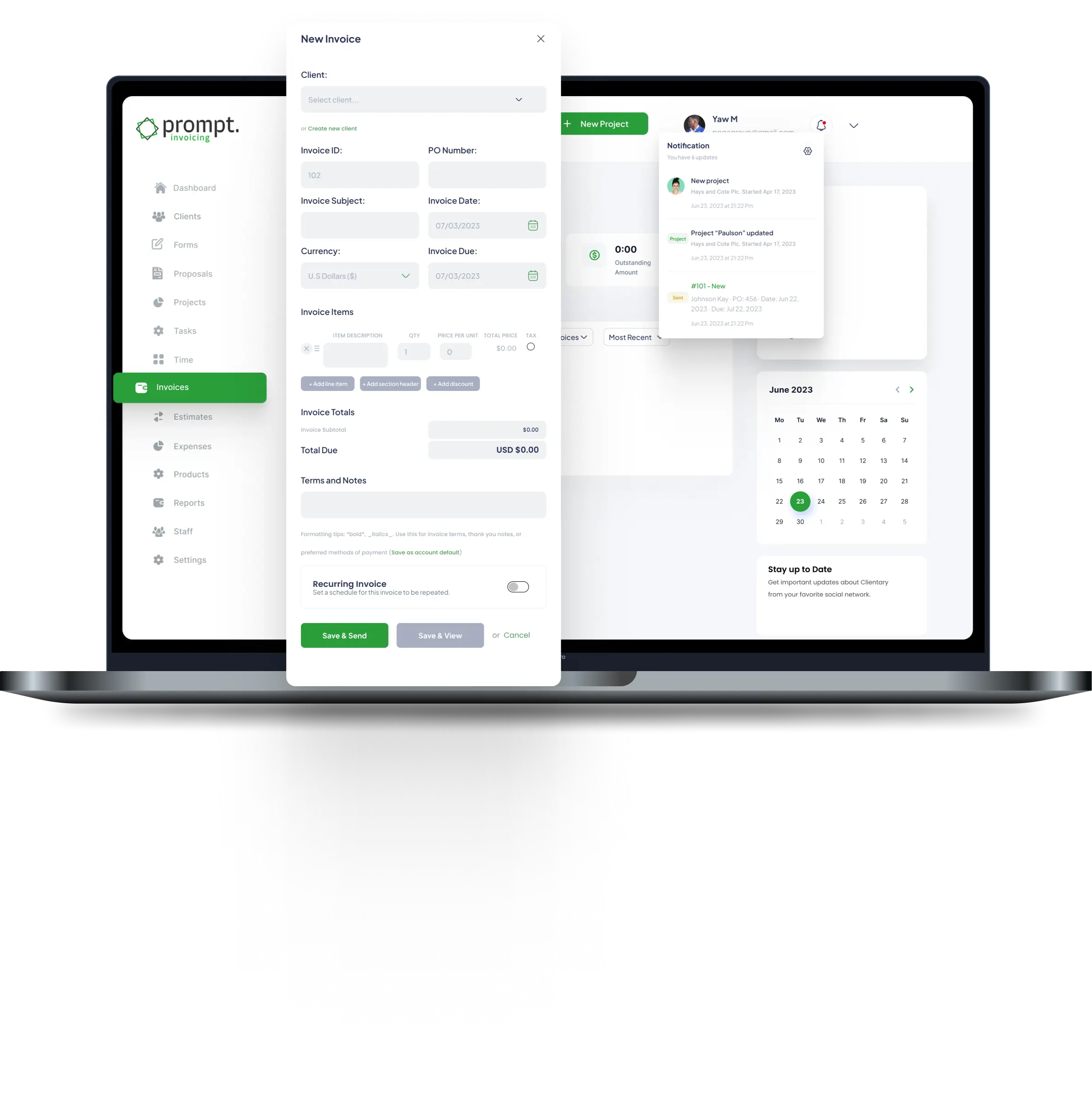
Prompt Integrated is a cloud-based business management platform built for Ghanaian businesses — managing invoices, projects, expenses, payroll, and payments in one place. But Prompt Integrated is not just a software platform. It is a gateway into Ghana’s fintech ecosystem — designed to give every Ghanaian business, regardless of size, access to the same digital financial infrastructure that the country’s largest companies take for granted.
The platform’s integration with Payswitch Ghana — one of Ghana’s foremost payment technology companies — is already live and actively transforming how Prompt Integrated users get paid. When a business sends an invoice through Prompt Integrated, the Payswitch integration turns that invoice into an active, payment-enabled request. Clients can pay directly, digitally, and immediately — without bank visits, manual transfers, or payment delays. Setting up the integration takes just a few clicks within Prompt Integrated’s payments module, requiring no technical expertise whatsoever.
This same powerful integration is being extended to payroll. Through the Payswitch integration, employers will be able to disburse salaries directly to employees via digital payment channels — from within the same platform used to calculate payroll, generate payslips, and manage PAYE and SSNIT deductions. For businesses with employees across different parts of Ghana, or staff who rely on mobile money for salary receipt, this represents a significant leap forward in payroll convenience and reliability.
Looking ahead, Paystack — one of Africa’s most trusted payment platforms, acquired by Stripe and operating across Ghana, Nigeria, and beyond — is in the pipeline as Prompt Integrated’s next major payment integration. When live, Paystack will extend the payment options available to Prompt Integrated users for both invoice collection and salary disbursement, giving businesses the flexibility to offer clients and employees a wider range of convenient digital payment methods. For businesses with customers or staff across multiple African markets, Paystack’s regional footprint makes this a particularly exciting addition to the platform’s capabilities.
Together, Payswitch today and Paystack tomorrow represent Prompt Integrated’s vision for what a truly integrated business management platform looks like in Ghana — one where invoicing, project management, expense tracking, payroll, and payments are not separate functions connected by manual processes, but a single, seamless financial operating system powered by the best of Ghana’s fintech ecosystem.
The Business Case Has Never Been Stronger
For investors, the case for African fintech in 2026 is as strong as it has ever been. Population growth, rapid urbanisation, rising smartphone penetration, and a young workforce hungry for digital financial services are structural tailwinds that will drive this sector for decades. The GSMA projects that mobile internet users in Sub-Saharan Africa will reach 600 million by 2030 — creating an ever-expanding addressable market for digital financial services of every kind.
For businesses operating in Ghana right now, the case is equally compelling. Every day that a business relies on manual invoicing, paper-based expense tracking, or cash salary payments is a day of unnecessary cost, risk, and inefficiency. The tools to do better already exist — and they are accessible, affordable, and designed for the realities of the Ghanaian business environment.
Conclusion: The Revolution Will Not Wait — Join It
Africa’s fintech revolution is not a story about what might happen. It is a story about what is already happening — in the payment apps on millions of phones, in the digital invoices flying between businesses, in the salary disbursements landing in workers’ mobile wallets at the end of every month.
The businesses and investors that move with this revolution will find themselves on the right side of one of the most significant economic transformations in modern history. Those that wait will find themselves playing catch-up in a market that moves quickly and rewards early movers generously.
Prompt Integrated is built for the businesses that want to move now — leveraging Ghana’s world-class fintech ecosystem through integrations with Payswitch and the coming Paystack partnership to manage invoices, projects, expenses, payroll, and payments in one powerful, connected platform.
The revolution is open for business. The only question is whether your business is ready to be part of it.
Step into Ghana’s fintech future today. Get started with Prompt Integrated and connect your business to the payments ecosystem that is transforming how Ghana does business.






Leave A Comment