

March 07, 2026
article by the prompt team
Understanding how payroll works is crucial for businesses in Ghana to ensure smooth operations, regulatory compliance, and employee satisfaction. Whether you’re a startup hiring your first employee or an established business scaling your workforce, getting payroll right from the start saves you time, money, and potential penalties.
In this guide, we break down the key steps of the payroll process in Ghana, the regulations you need to know, and how cloud-based tools like Prompt Integrated can simplify the entire process.
1. Employee Registration
The payroll process begins with registering your employees with the relevant statutory bodies. As an employer, you’ll need to collect key details including Tax Identification Numbers (TINs), social security numbers, and personal information to establish accurate records.
These details are used to register employees with:
- Social Security and National Insurance Trust (SSNIT) — for mandatory Tier 1 social security contributions
- Ghana Revenue Authority (GRA) — for income tax (PAYE) registration
- A licensed private fund manager — for Tier 2 occupational pension and/or voluntary Tier 3 provident fund contributions
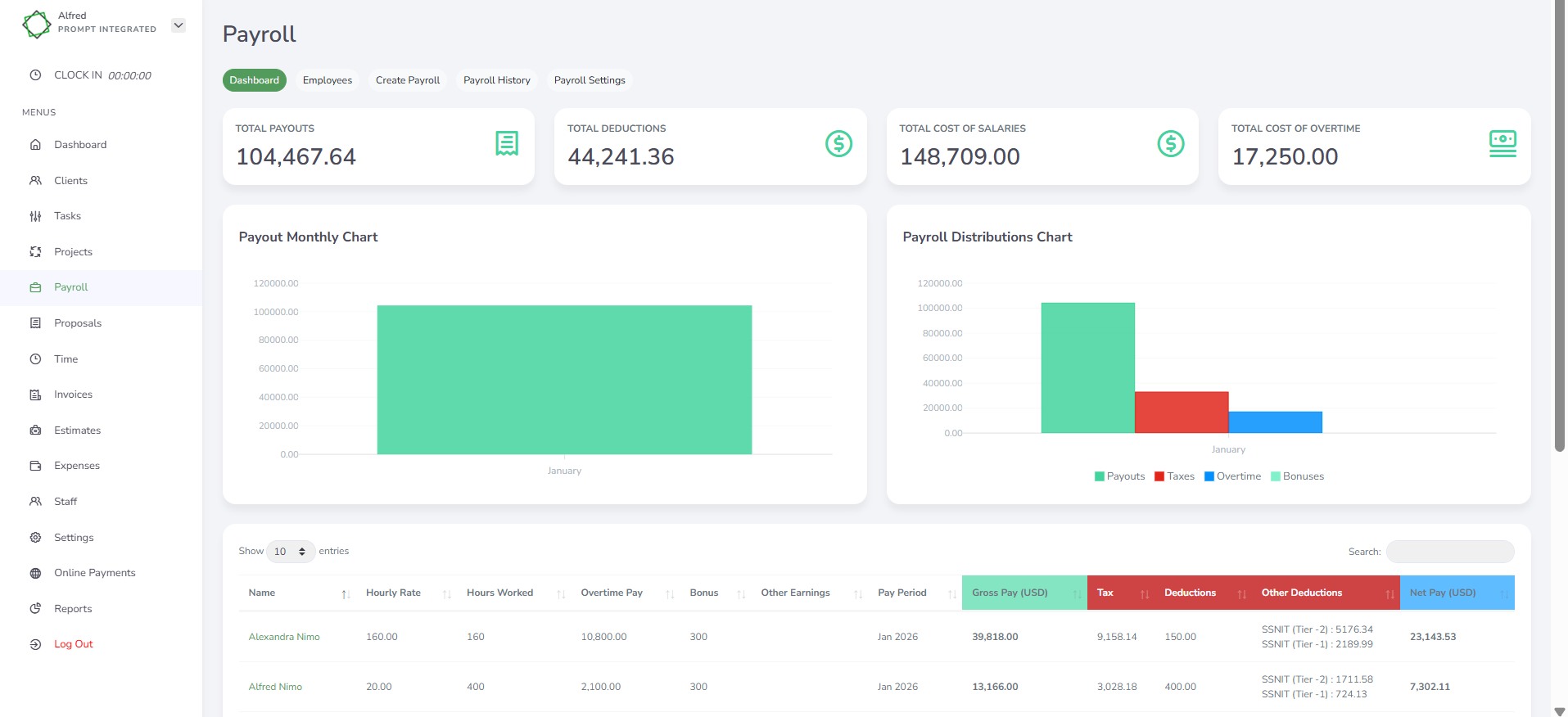
Keeping accurate employee records from day one is essential — and Prompt Integrated’s payroll module provides a centralised system to store and manage all employee information securely.
2. Salary Structure and Deductions
Once employees are registered, employers define the salary structure for each role. This typically includes basic wages, allowances, and additional benefits.
From the gross salary, the following statutory deductions are calculated:
- SSNIT (Tier 1): Employee contribution is 5.5% of basic salary; employer contribution is 13% (of which 2.5% goes to the National Health Insurance Levy)
- PAYE: Calculated according to GRA’s graduated income tax schedule
- Tier 2 Pension: Managed by a licensed private trustee
Getting these calculations right every month is non-negotiable. Prompt Integrated automates these deductions based on current statutory rates, reducing the risk of costly errors.
3. Tax Compliance (PAYE)
Tax compliance is one of the most critical — and most scrutinised — aspects of payroll in Ghana. Employers are legally required to deduct Pay-As-You-Earn (PAYE) taxes from employees’ salaries each month and remit them to the Ghana Revenue Authority promptly.
Filing and payment are currently done via the GRA Tax Portal and must be completed by the 15th of the following month. Late filings attract penalties, so timeliness is essential.
With Prompt Integrated’s payroll tools, PAYE calculations are automated and records are maintained in an audit-ready format, making monthly filings faster and more accurate.
4. Social Security Contributions (SSNIT)
Both employers and employees are required to make monthly contributions to the Social Security and National Insurance Trust (SSNIT). The employer deducts the employee’s 5.5% share from their salary and adds their own 13% contribution before remitting the combined amount.
SSNIT contributions can currently be submitted via email to your assigned SSNIT branch or processed online through the SSNIT Employer Self-Service Portal. Staying on top of this obligation is a key responsibility for HR and finance teams alike.
5. Payslip Generation
After payroll is processed, every employee should receive a detailed payslip outlining their gross earnings, individual deductions (PAYE, SSNIT, Tier 2), and net pay. This transparent document is not just best practice — it builds trust and reduces pay-related disputes.
Prompt Integrated automates payslip generation, producing accurate, professionally formatted payslips that can be distributed electronically. Employees can access their payslips at any time through a secure portal, reducing HR admin and promoting transparency.
6. Payment Methods
Salary payments in Ghana are typically made via direct bank transfer, with funds deposited directly into employees’ designated bank accounts on a set payday. Some businesses, particularly smaller operations, may still issue physical cheques, though electronic payments are increasingly the norm.
Prompt Integrated’s payments module supports streamlined salary disbursements, keeping all payment records organised and traceable in one place.
7. Compliance with Labour Laws
Beyond taxes and social security, Ghanaian employers must comply with the Labour Act (Act 651), which governs minimum wage requirements, working hours, leave entitlements, and termination procedures.
The National Daily Minimum Wage is reviewed periodically by the National Tripartite Committee — employers must ensure their salary structures remain compliant with the current rate. Non-compliance can result in labour disputes, fines, or legal action.
8. Record-Keeping and Auditing
Accurate payroll record-keeping is both a legal requirement and a business best practice. Employers must maintain comprehensive records including employee details, salary history, deduction schedules, and tax documentation — all of which may be requested during audits by the GRA, SSNIT, or other regulatory bodies.
Prompt Integrated stores all payroll records digitally and securely in the cloud, making it straightforward to retrieve historical data and respond confidently to any audit or compliance query.
9. Annual Returns and Reporting
At the end of each tax year, employers are required to submit annual returns to the GRA, summarising each employee’s total earnings, PAYE deductions, and other statutory contributions for the year. This reporting ensures transparency and is a key compliance obligation for every registered employer in Ghana.
With all payroll data centralised in Prompt Integrated, generating the reports needed for annual returns becomes a straightforward task rather than a year-end scramble.
10. Leveraging Technology for Smarter Payroll
Modern payroll management in Ghana is increasingly technology-driven. Cloud-based platforms eliminate the manual errors, version-control issues, and time costs associated with spreadsheet-based payroll.
Prompt Integrated brings payroll together with invoicing, project management, expense tracking, and payments — giving Ghanaian businesses a single platform to manage their entire financial operation. No more switching between disconnected tools or reconciling figures from multiple systems.
Conclusion
Payroll in Ghana involves careful attention to legal requirements, employee welfare, and financial transparency. From SSNIT contributions and PAYE filings to payslip generation and annual returns, every step matters — and every error carries a cost.
The businesses that get payroll right are those that put the right systems in place early. Prompt Integrated is built for exactly that — helping Ghanaian businesses of all sizes manage payroll accurately, stay compliant, and free up time to focus on growth.
Ready to simplify payroll for your business? Get started with Prompt Integrated today.








Leave A Comment